Quick answer
Dry skin itches because the outer layer has lost water and its protective structure has gone patchy, leaving nerve endings closer to the surface more easily triggered — the itch is the dryness being reported, not a separate problem. Scratching then makes it worse: it relieves for a few seconds, damages the barrier further, exposes more nerve endings, and can set off local inflammation that itches in its own right. That loop is the itch-scratch cycle, and breaking it takes two things — interrupting the immediate urge with cool rather than nails, and repairing the barrier daily by washing gently in warm water and moisturizing on still-damp skin. Nights are worst because skin loses more water then and warmth heightens the sensation. And itch that’s severe, widespread, sleep-disrupting, or accompanied by a rash needs a doctor rather than another product.
Answers at a glance6 quick questions
Why the itch?
Exposed nerve endings in a patchy barrier.
Why scratch worse?
It damages the barrier further.
Fast relief?
Cool cloth, not nails.
Worse at night?
Water loss + warmth + no distraction.
Hot showers?
Relief now, worse after.
See a doctor?
Severe, spreading, or sleep-wrecking.
01 The short answer
Dry skin is uncomfortable. Itchy dry skin is a different category of problem — the kind that wakes people at two in the morning, that turns a winter evening into a battle of willpower, and that leaves shins scratched raw by people who genuinely meant not to.
The useful thing to understand is that the itch and the dryness are the same event. When the outer layer loses water and its structure gets patchy, nerve endings sitting near the surface become easier to trigger — so the itch is the dryness reporting itself. And the natural response, scratching, damages that structure further, which produces more itch. The symptom recreates the cause.
So this is the whole picture: what’s actually happening in the skin, why scratching is a trap rather than a weakness, what genuinely interrupts the urge in the moment, the daily routine that fixes the underlying problem, and the clear signals that mean this has stopped being a skincare question and become a medical one.
02 What the itch actually is
Some groundwork, because itch is stranger than it appears:
- It’s a nerve signal, not a skin state. Specialized nerve endings in the skin detect certain stimuli and send a signal the brain interprets as itch. The sensation is produced centrally; the trigger is peripheral.
- It’s a protective system. Itch evolved to make you remove things from your skin — insects, plants, irritants. Scratching is the built-in response, and for its original purpose it works well. The trouble is what happens when the trigger is the skin itself.
- Itch and pain are related but distinct. They travel different pathways and produce opposite urges: pain makes you withdraw, itch makes you engage. Which is why scratching hard enough to hurt can briefly stop an itch — the pain signal interrupts it, at the cost of damage.
- And it’s highly suggestible. Reading about itch makes people itchy; watching someone scratch is contagious. That’s not weakness, it’s a well-documented quirk of the system — and it’s part of why the cycle is so hard to break by willpower alone.
03 Why a dry barrier itches
Now the mechanism connecting dryness to that signal:
- Start with the barrier. The outer layer works like brick and mortar — cells held in a lipid matrix — and its job is keeping water in and irritants out. It sits above the nerve endings that generate itch.
- Dry skin means a compromised barrier. Lose water and lipids and the structure goes patchy. Now more of what lands on skin — soap residue, fabric, ordinary environmental irritants — reaches deeper than it should, and the nerve endings are easier to reach.
- Dry skin is also stiff skin. A hydrated outer layer is flexible; a dry one is rigid, and rigid skin develops fine cracks with ordinary movement. Every crack is another point where the barrier isn’t doing its job.
- And the nerve endings themselves become more reactive. In persistently dry or irritated skin, the itch system tends to become more sensitive rather than less — so the same stimulus produces more itch than it would have on healthy skin.
Why this reframes the treatment
If the itch is a barrier problem, then anything that treats the sensation without repairing the barrier is temporary by design. That’s why the answer to itchy dry skin is mostly unglamorous maintenance — gentler washing and consistent moisturizing — rather than something dramatic. The dramatic-feeling interventions are usually the ones that make it worse.
04 The itch-scratch cycle
The loop that turns an annoyance into a problem:
01
Itch
A dry, compromised barrier triggers the signal. At this stage it’s mild and manageable, and it’s the last point where doing nothing is easy.
02
Scratch — and genuine relief
Scratching works, briefly. It interrupts the itch signal and feels good, which is exactly why this is a trap rather than a failure of discipline. Your nervous system is rewarding the behavior in real time.
03
Damage
Fingernails on a barrier that’s already compromised remove more of it. Micro-abrasions, more exposed nerve endings, sometimes broken skin. The relief cost something you can’t see.
04
Inflammation
Damaged skin responds with local inflammation — redness, warmth — and inflammation is itchy in its own right. So now there are two sources of itch where there was one.
05
More itch, and round again
The area is now itchier than before you scratched it, so you scratch more, and each turn of the loop makes the next one likelier. Left running for weeks, skin can thicken and toughen in the scratched area — which is itchy too.
The important point for anyone stuck in this: it isn’t a willpower problem. The loop is built out of a functioning reward response and a real physical mechanism. Interrupting it takes tactics, not resolve — which is the next two sections.
05 Why it’s worse at night
Almost everyone with itchy skin reports the same thing: it’s worst in bed. Several causes converge:
- Skin loses more water overnight. Water loss through skin follows a daily rhythm and runs higher at night, so the barrier is under more pressure exactly when you’re lying still with nothing else to think about.
- Warmth increases itch. Getting warm under a duvet raises skin temperature, and warm skin is itchier skin — which is also why the itch often starts within minutes of getting into bed.
- Bedrooms are dry. Heating warms air without adding moisture, so the room you spend eight hours in is drier than any other — the point we made in the fall transition guide, and it matters most here.
- Nothing is competing for attention. During the day, a mild itch is drowned out. At night there’s no distraction, and the sensation gets the full spotlight.
- What helps: a heavier moisturizer applied before bed, a cooler bedroom, breathable bedding, and a humidifier if the air is dry. Scratching in your sleep is real — short nails and covering the area with soft clothing make it much less damaging.
06 The hot shower trap
The most common self-inflicted mistake, and it feels wonderful at the time:
- Hot water relieves itch briefly. Heat overwhelms the itch signal — a hot shower on itchy skin is genuinely satisfying in the moment, which is why people reach for it.
- And then it makes it worse. Hot water strips skin oils faster than warm water, so you emerge with a more compromised barrier than you went in with. The itch that follows, twenty minutes later, is usually worse than the one you were treating.
- The same goes for scalding an itchy patch under the tap. A common trick, same trade — short relief bought with barrier damage.
- What to do instead: warm, short showers; gentle cleanser only where needed; pat dry to damp; moisturize within a few minutes. The full version is in the bathing guide, and the principle holds at every age.
- Cool is the better lever. Cooling interrupts itch without stripping anything — which is why it leads the next section.
07 Breaking the cycle: the immediate moves
What to do when the urge is happening right now — tactics rather than resolve:
- Cool the area. A cool damp cloth held on the spot for a few minutes interrupts the signal without damaging skin. This is the single most useful substitute for scratching, and it works because cool and itch travel overlapping pathways.
- Press instead of scratch. Steady pressure with a flat palm gives some of the sensory interruption without nails involved. Not as satisfying; far less costly.
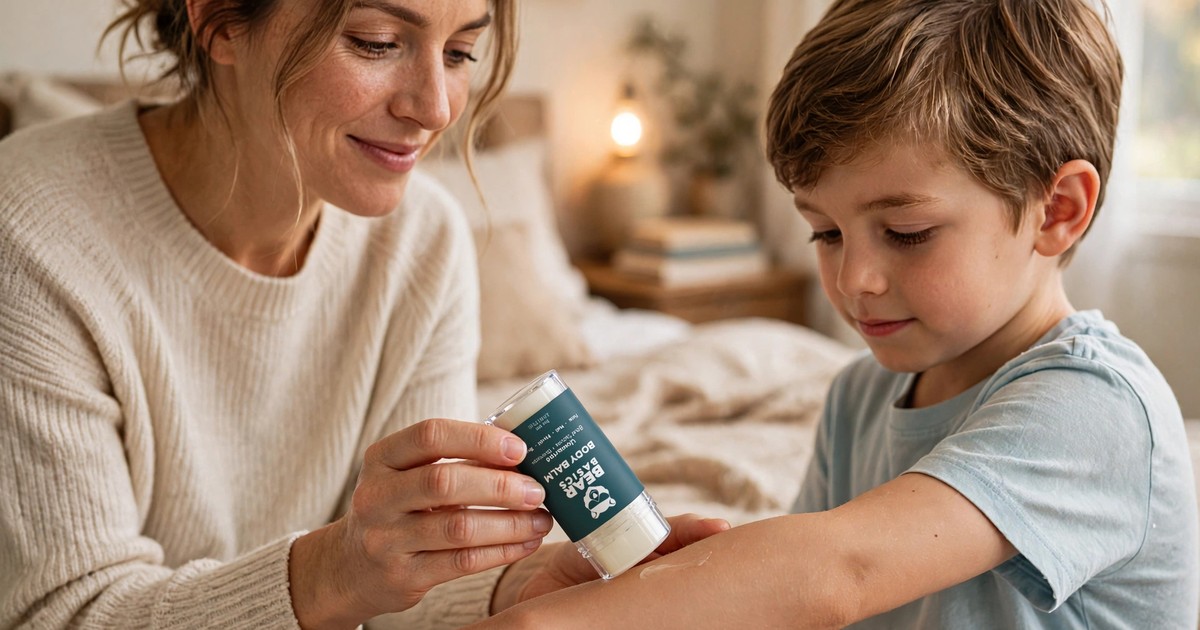
- Moisturize the itchy spot. Applying a balm to an itchy area does two things — the physical act occupies the urge, and the barrier gets some immediate support. If skin is damp, better still.
- Cover it. Soft clothing over an itchy patch puts a layer between skin and fingernails, which matters enormously at night and for children.
- Keep nails short. The least glamorous and most effective intervention in this whole article. Short nails turn scratching into rubbing, which does far less damage.
- Give it sixty seconds. Itch waves rise and pass. Knowing that a wave is temporary makes riding it out plausible in a way that “just don’t scratch” never does.
08 Breaking the cycle: the daily routine
The immediate tactics buy time; this is what actually resolves it:
- Warm, short washing with gentle cleanser — and soap only where it’s needed rather than over the whole body. Every wash removes some of the oil layer, so the fewer harsh washes, the less ground to make up.
- Moisturize on still-damp skin, every time. Within a few minutes of towelling off, while the water is still there to seal — the damp-skin technique. This is the load-bearing habit; nothing else in the routine substitutes for it.
- Go richer where it itches. Occlusive, fat-based products slow water leaving more effectively than light lotions — the sealing job is what a compromised barrier needs most.
- Twice daily during a bad patch. Morning and night rather than once, until things settle. Consistency matters more than the product.
- Reduce the irritants. Fragrance-free products, gentler laundry detergent, and soft fabrics against itchy skin — a compromised barrier lets more of everything through, so this is the season to remove the common irritants rather than introduce new ones.
- Address the air. A humidifier where you sleep, and a thermostat that isn’t running hot.
- Expect it to take a couple of weeks. Barriers repair gradually. The itch usually eases well before the skin looks fully better, which is encouraging if you know to expect it.
Want the free family bundle?Two Color & Grow coloring books, our Fam Jams family music, and a plain-English skincare guide — free. Grab the bundle — instant download. 09 What we don’t recommend
A few popular itch remedies we’d steer away from, with reasons:
- Very hot water on the itch. Covered in section 6 — the clearest example of buying short relief with longer-term damage.
- Scrubbing or exfoliating an itchy patch. The instinct to remove the flakes is understandable and counterproductive: flaking is a symptom of a damaged barrier, and abrading it removes more of what’s left.
- Fragranced “soothing” products. Fragrance is the most common cosmetic irritant, and compromised skin is more reactive, not less. A scented lotion on itchy skin is a coin flip.
- Rubbing alcohol, vinegar, or other home astringents on itchy skin — drying agents applied to a dryness problem.
- Layering multiple new products at once. If something helps or irritates, you want to know which — the debuggability principle matters most when skin is already unhappy.
- And anything medicated without asking. Over-the-counter itch treatments exist and some are genuinely useful, but which one, where, and for how long is a pharmacist or doctor question — particularly for children, on the face, or for anything used more than briefly.
10 Kids and scratching
Children are worse at not scratching, for entirely understandable reasons. What actually helps:
- Reduce the itch rather than police the hands. “Stop scratching” asks a child to override a reward response with willpower they don’t have. Lowering the itch is the only strategy that works.
- Nails short, always. The highest-value five minutes available — it turns damage into rubbing.
- Cover itchy areas with soft, breathable layers, and consider long sleeves at night. Cotton mittens are a standard approach for small children who scratch in their sleep.
- Cool the room and lose a layer of bedding. Overheated children itch more, and this is one of the easier variables to change.
- Moisturize after every bath on damp skin, and keep baths warm and short — the routine from the toddler guide.
- Give them a replacement action. Pressing a cool cloth, rubbing with a flat hand, or coming to you for help — children do better with something to do than with a prohibition.
- And call the pediatrician if a child is breaking skin, losing sleep, or the itch is persistent. Eczema is common at these ages and has real treatments — a child scratching through the night doesn’t need a better moisturizer, they need an assessment.
11 Winter, and why it spikes
Why this article publishes in September rather than January: the itch season is coming, and it’s predictable.
- Cold air outside holds less moisture, so it pulls water from skin faster than summer air does.
- Heating dries the air inside, all day and all night. Between the two, there’s nowhere in a winter day that isn’t drier than August.
- Hot showers become more tempting exactly when skin can least afford them — the seasonal irony from the transition guide.
- And more layers, more wool. Fabric against dry skin is a mechanical irritant, and rough or wool-next-to-skin is a common trigger people don’t connect to the itch.
- Which makes the timing advice simple: start the routine in section 8 now, before the itch arrives. Preventing a cycle is dramatically easier than breaking one that’s been running for six weeks.
12 When itch means see a doctor
When itch needs a doctor, not a product
See a professional if: the itch is severe or persistent despite consistent gentle care; it disrupts your sleep; skin is broken, weeping, crusted, or looks infected; there’s a rash, swelling, or hives; the itch is generalized over your whole body without obvious dry skin; or it appears alongside other symptoms such as fatigue, weight change, or feeling unwell. Widespread itch without a skin cause can have internal causes that need identifying, and conditions like eczema have effective treatments that no moisturizer substitutes for. For a child who is scratching until they bleed or losing sleep, call your pediatrician rather than waiting it out.
- The practical rule: gentle care and consistent moisturizing should produce noticeable improvement within a couple of weeks. If it doesn’t, that’s information — not a reason to try a fifth product.
- Broken skin changes the situation — that’s no longer a moisturizing question, and infection risk is real.
- Sleep is the threshold worth respecting. Itch that wakes you or your child is affecting more than skin, and it’s a reasonable thing to bring to an appointment on its own.
- Asking early costs nothing, and it’s the standing position across everything we write — from eczema-prone routines onward.
13 The bottom line
Dry skin itches because a barrier that has lost water and lipids leaves nerve endings easier to trigger — the itch is the dryness reporting itself. Scratching relieves it for seconds, damages the barrier further, invites inflammation, and produces more itch than before: a genuine physiological loop rather than a failure of discipline.
Breaking it takes both halves. In the moment: cool it, press it, cover it, keep nails short, and wait out the wave. Daily: warm short washing, gentle cleanser only where needed, and something rich on still-damp skin every time — twice a day through a bad patch. Start before the cold does, and get help if it’s severe, spreading, breaking the skin, or costing anyone sleep.
"It isn’t a willpower problem. Scratching is a reward response built on a real mechanism — which means it takes tactics, not resolve."— The honest verdict
The 6 things to remember
- The itch is the dryness reporting itself — a patchy barrier leaves nerve endings exposed.
- Scratching relieves briefly, damages the barrier, and produces more itch: a real cycle, not weakness.
- In the moment: cool cloth, steady pressure, cover it, short nails, ride out the wave.
- Daily: warm short washing, gentle cleanser where needed, rich moisturizer on damp skin.
- Hot water and scrubbing feel like relief and make it worse.
- Severe, spreading, broken, or sleep-disrupting itch is a doctor’s question.
Frequently asked
Why does dry skin itch so much?
When the outer layer of skin loses water and its protective structure gets patchy, nerve endings near the surface become more exposed to irritation and more easily triggered. The skin also becomes stiffer and more prone to tiny cracks, which adds to the signalling. So the itch isn’t a separate problem from the dryness — it’s the dryness being reported.
Why does scratching make itching worse?
Scratching gives short-term relief and then damages the barrier further, which exposes more nerve endings and produces more itch. It can also trigger local inflammation, which is itchy in its own right. The result is a self-sustaining loop — the itch-scratch cycle — where the response to the symptom keeps recreating the cause.
How do I stop the itch quickly?
Cool it rather than scratch it: a cool damp cloth for a few minutes, or briefly cooling the area, interrupts the signal without damaging skin. Then moisturize while skin is still slightly damp, and cover the area with clothing if that helps you leave it alone. Fingernails kept short make the difference between scratching and real damage.
Why is dry skin itchier at night?
Several things line up at once: skin loses more water overnight, bedrooms are often warm and dry from heating, warmth itself increases itch sensitivity, and there’s nothing else competing for your attention. Applying a heavier moisturizer before bed and keeping the bedroom cooler both help with the version that wakes people up.
Does hot water make itchy skin worse?
Usually yes. Hot water strips skin oils faster than warm water, so it leaves the barrier more compromised afterward — and the immediate relief people feel from a hot shower on itchy skin is typically followed by a worse itch once the skin cools and dries. Warm, short, and moisturizing on damp skin is the more useful pattern.
Can dry skin itch without looking dry?
It can. Skin can be losing water and functioning poorly as a barrier before there’s visible flaking or roughness, particularly early on or in areas with thicker skin. If skin itches consistently, treating it as dry and being gentler with it is a reasonable first move regardless of appearance — but persistent itch without a clear cause is worth having looked at.
When is itching a sign of something more serious?
When it’s severe, persistent, or disrupts sleep; when it comes with a rash, swelling, weeping, or signs of infection; when it’s all over the body without obvious dryness; or when it appears alongside other symptoms like fatigue or weight change. Generalized itch can have internal causes, and itch that isn’t improving with basic care deserves a doctor’s assessment rather than another cream.
What helps kids stop scratching?
Reduce the itch rather than policing the hands: keep nails short, dress them in soft layers that cover itchy areas, keep the room cool at night, and moisturize consistently after baths. Give them something acceptable to do instead — pressing or cooling rather than scratching. And if a child is scratching enough to break skin or lose sleep, that’s a call to your pediatrician.
Megan Smith
Co-Founder, Bear Basics
Megan co-founded Bear Basics and leads design. As a mom, she writes our gentlest, most practical guides — on ingredients, sourcing, and simple family skincare — with an emphasis on honest, well-sourced, and simple. Read the full story →
The unglamorous part that works.Rich, unscented, water-free balms for the damp-skin minute — twice daily through a bad patch. Prefer Amazon? Find us there too.Shop body care