Quick answer
Kids become persistent through hundreds of ordinary moments in which trying felt worthwhile — not through encouragement in the abstract. The most useful levers: praise the effort and the strategy rather than the ability, because a child praised for being clever has something to protect when things get hard; let them sit in manageable difficulty without being rescued in the first thirty seconds; handle the frustrated feeling before attempting the task, since nobody problem-solves mid-meltdown; and let them see you struggle with things out loud. Just as important is knowing that quitting is sometimes correct — a bad fit, a miserable environment, an activity that was always more yours than theirs. And frustration that’s extreme, constant, or tangled up with a child’s sense of their own worth is worth raising with a teacher or your pediatrician rather than pushing through.
Answers at a glance6 quick questions
Best lever?
Praise effort and strategy.
Why they quit?
Too hard, or struggling feels unsafe.
Mid-meltdown?
Feeling first, task later.
Rescue them?
Not immediately — wait it out.
Ever quit?
Yes — bad fit is a real reason.
Get help when?
Constant distress or avoidance.
01 The short answer
Every parent has watched it: the tower falls for the fourth time, and the child sweeps the whole thing across the floor and announces they are never building anything again. Or the shoelace won’t cooperate, or the bike wobbles, or the note on the recorder comes out wrong, and the whole enterprise is abandoned with real feeling.
The instinct in that moment is to say something encouraging. The trouble is that persistence isn’t built by encouragement — it’s built by the accumulated experience that trying tends to be worth it. That experience is assembled in small, mostly annoying moments, and what we do in them matters considerably more than anything we say about not giving up.
So this guide is about those moments: why children actually quit (rarely laziness), how praise can quietly undermine the thing it’s aiming at, what to do while a child is mid-frustration, how to pitch difficulty so effort pays off — and the part that gets left out of most versions of this conversation, which is that sometimes quitting is the correct decision and pretending otherwise does no one any favors.
02 What persistence actually is
Worth defining, because the word gets used to mean several different things:
- It’s not enjoying difficulty. Almost nobody enjoys the frustrating middle of a hard thing. Persistent people aren’t having a better time — they’ve just learned the feeling is survivable and temporary.
- It’s not never quitting. People who finish worthwhile things also abandon plenty of unworthwhile ones. Indiscriminate persistence isn’t a virtue; it’s a lack of judgment.
- It is the belief that effort changes outcomes. That’s the core. A child who expects trying to make a difference will try; one who has learned that it doesn’t, won’t. Everything in this article is really about protecting that expectation.
- And it’s domain-specific. The child who abandons a puzzle in ninety seconds may spend six hours on a drawing. That isn’t inconsistency — it’s information about where they currently expect effort to pay off, which is far more useful than a verdict about their character.
The reframe worth keeping
“My child gives up easily” is a statement about a trait. “My child hasn’t yet learned that effort works on this” is a statement about a situation — and situations can be changed. The second framing also happens to be more accurate more of the time.
03 Why kids quit
Children quit for reasons, and the reason determines the response. The three common ones:
- It’s genuinely too hard right now. Not too hard forever — too hard today, for this child, with these skills. Quitting is a rational response to a task well beyond reach, and the fix is the difficulty, not the child (section 7).
- Struggling feels unsafe. This is the one parents most often miss. If a child has learned that being good at things is what earns approval, then visibly struggling is a threat — and quitting early is protective. “I didn’t really try” preserves the possibility that they could have. This is where praise history comes back to bite (section 4).
- They don’t have a way to handle the feeling. Frustration is physically unpleasant, and young children in particular have very little machinery for riding it out. Quitting ends the feeling immediately, which is an entirely understandable trade.
- What it usually isn’t: laziness or a character defect. Those framings feel explanatory and lead nowhere useful — and children who hear them tend to adopt them.
Practical move: before responding, ask yourself which of the three you’re looking at. Too-hard needs adjustment; unsafe needs reassurance; feelings need company. The wrong response to the right problem is why encouragement so often bounces off.
04 The praise problem
Now the counterintuitive one, and probably the highest-leverage change available: the way most of us instinctively praise can make children less willing to persist.
- The mechanism: praising a child for being smart, talented, or a natural hands them a label — and labels have to be defended. The moment a task gets hard, continuing risks the label. Quitting protects it. The child isn’t being fragile; they’re protecting the thing you told them mattered.
- Which is why bright kids often quit fastest. Children accustomed to finding things easy have the most to lose when something isn’t, and frequently the least practice at the frustrated feeling. “I’m just not a math person” at nine is often a label-protection strategy rather than a self-assessment.
- Effort praise gives them something repeatable. “You kept going when it got confusing” describes an action they can do again tomorrow. “You’re so smart” describes a fixed quantity they can only fail to live up to.
- The trap to avoid: hollow effort praise. “Great effort!” delivered to a child who knows they barely tried teaches that praise is noise. Children detect this instantly, and it devalues the currency for when it’s real.
Want the free family bundle?Two Color & Grow coloring books, our Fam Jams family music, and a plain-English skincare guide — free. Grab the bundle — instant download. 05 Praise that builds something
What to say instead. The pattern is specific and descriptive rather than evaluative:
- Name the strategy. “You tried it three different ways before it worked.” This tells a child that having approaches is the skill — which is the actual skill.
- Name the return. “You came back to it after being annoyed.” Returning after frustration is arguably the whole capacity we’re discussing, and it goes unremarked constantly.
- Name the duration. “You stuck with that for a long time.” Especially valuable for a child who doesn’t often, because it makes a rare behavior visible.
- Ask rather than assess. “How did you figure that out?” puts them in the position of explaining their own thinking, which is worth more than any compliment you could pay it.
- Praise the failed attempt too. This is the one that changes households. If effort only gets acknowledged when it succeeds, then you’ve praised the outcome after all — children work that out fast. “That didn’t work, but you had a real go at it” is the sentence that makes trying safe.
- Keep it low-key. Ordinary, noticing-your-child tone. Elaborate celebration of routine effort reads as surprise that they managed it.
06 Sitting with the frustration
The hardest part in practice: what to do while your child is furious at a puzzle. Some structure for it:
01
Handle the feeling before the task
A frustrated child cannot problem-solve — the part of them that generates strategies is temporarily offline. Any suggestion offered now, however good, will be rejected on principle. Calm first; the task will still be there.
02
Name it without shrinking it
“That is really annoying.” Not “it’s okay” (it isn’t, to them) and not “don’t get upset” (unhelpful and slightly insulting). Being accurately described is regulating in itself, for children and for adults.
03
Wait longer than is comfortable
The urge to jump in — with the answer, the fix, or the encouragement — arrives within seconds and usually too early. The pause is where a child discovers they can tolerate the feeling, which is a discovery you can’t make on their behalf. Stay close, stay quiet.
04
Offer the smallest possible help
When help is genuinely needed, give the least that unsticks them — a hint rather than the answer, holding one end rather than doing it. Enough to keep them in the game, not enough to take it over. Doing it for them ends the frustration and the learning simultaneously.
05
Allow the break, then the return
“Let’s leave it and come back” is a genuine strategy, not a defeat — adults use it constantly. It also creates the moment worth praising most: coming back. A child who learns that walking away can be temporary has learned something they’ll use forever.
07 Calibrating the difficulty
Persistence depends on effort actually paying off, which makes difficulty a parenting variable worth managing:
- Too easy teaches nothing. No effort required, so no evidence gathered about whether effort works. Pleasant, forgettable.
- Far too hard teaches the wrong lesson. A child who tries hard and still fails badly learns that trying doesn’t help — the precise opposite of the goal. Repeated often enough, this is how children conclude they’re “bad at” whole subjects.
- The target is reachable-with-work. Hard enough to require real trying, close enough that trying gets there. That’s where the belief in effort is actually built.
- Practical adjustments: break a task into a smaller piece, do the hard part together while they do the rest, choose the puzzle one notch down, or hold the bike for the first stretch. You’re not lowering standards — you’re putting the challenge in range.
- Watch for the sign you’ve missed the range: a child who gives up almost instantly is usually telling you the task is out of reach, not that they lack grit. Instant surrender is a difficulty signal.
08 Modeling it out loud
Children calibrate what struggling means largely by watching adults do it — and most of us hide ours:
- Narrate your own hard things. “This recipe isn’t working. I’m going to try it a different way.” Small, real, said out loud. Children who only ever see competent adults conclude that competence is the normal state and struggle is an aberration — specifically, theirs.
- Let them see the failed version too. Not just the eventual success. The batch that didn’t work, the thing you rebuilt twice. We put our own reasoning and revisions on this blog for adults for similar reasons — including the times we changed our minds.
- Show the annoyed part. Being visibly frustrated and continuing anyway is the demonstration. A parent who is never frustrated models something unattainable rather than something useful.
- Tell them about the things you gave up on, too. Including why, and whether you’d do it again. That’s the judgment half of persistence — and it sets up section 10.
- Careful with the retrospective heroics. “I practiced every day for a year” can land as a standard rather than an encouragement. The useful version is the middle of the story, not the triumphant summary.
09 The stories do some of the work
Stories are unusually good at this particular lesson, for a structural reason:
- A character can fail without it being your child’s failure. Watching someone else struggle and continue is instructive without being personal — the same distance that makes yesterday’s subject easier to discuss through a book than a lecture.
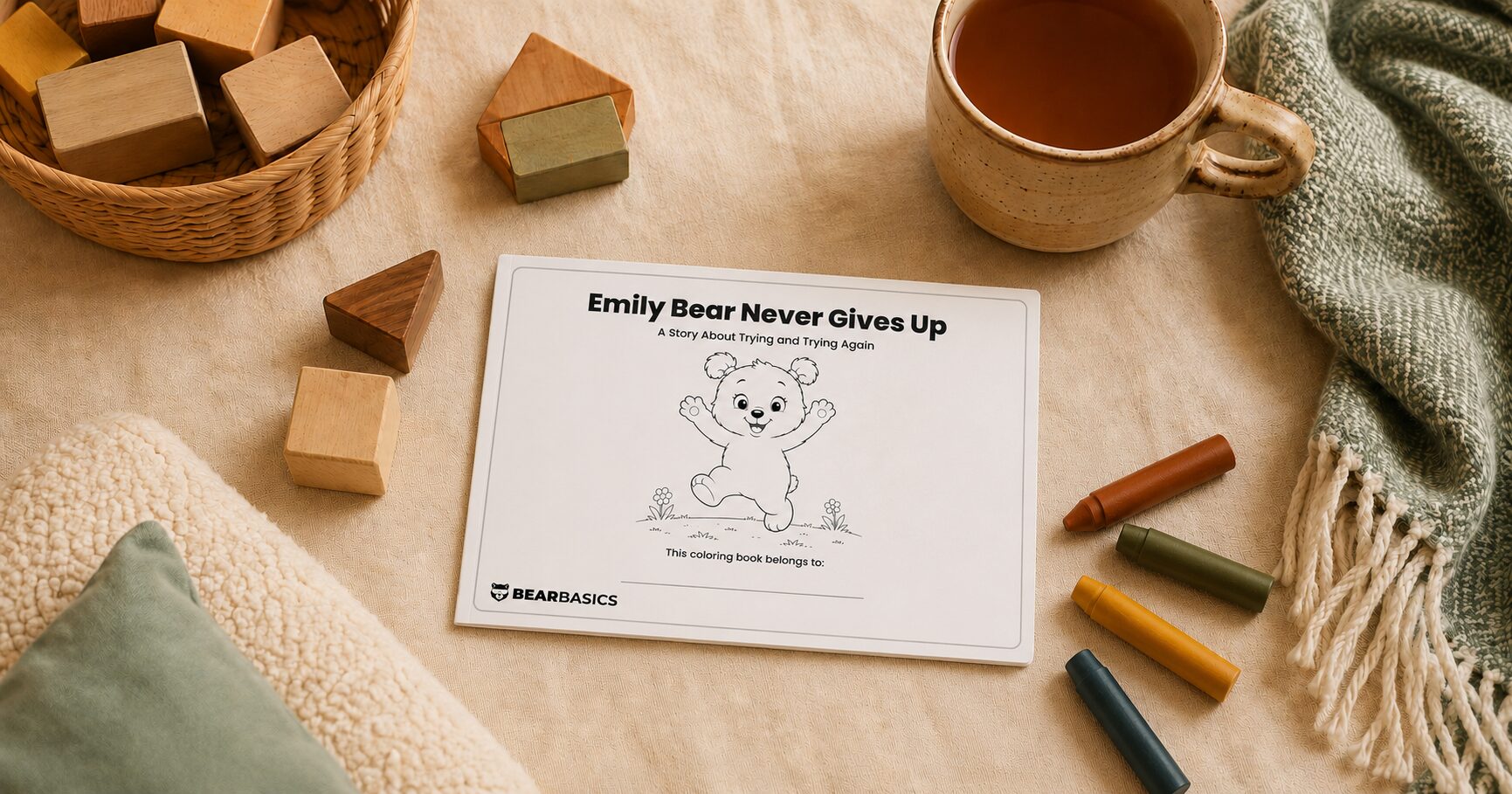
- The middle is the whole point. Most children’s stories about trying skip from problem to triumph. The useful ones sit in the discouraged middle for a while, because that’s the part kids need vocabulary for. Our second Color & Grow book is subtitled A Story About Trying and Trying Again for exactly that reason — the “and” is doing real work.
- Coloring adds time. A child working through a page with a crayon stays with the idea far longer than a read-through allows, which is part of why the format works.
- Ask, don’t explain. “What do you think she felt when it fell over?” will teach more than any moral you could append. Children are better at extracting the lesson than adults are at delivering it.
- Let them identify with the struggling part. The temptation is to point at the triumphant ending. The recognition that matters happens in the middle — “that’s how I feel about my bike” is the moment the book did its job.
10 When quitting is right
The section most articles on this topic omit, and it matters: sometimes quitting is the right answer, and treating all quitting as failure teaches poor judgment.
- Bad fit is a real reason. Not every child suits every activity, and discovering that is useful information rather than a character test. Trying things and concluding they aren’t for you is how anyone builds a sense of what is.
- Misery is a reason. Not the ordinary frustration of learning — that’s the process — but genuine, persistent unhappiness. A child dreading Tuesdays for months is telling you something you should probably believe.
- Something wrong in the environment is a reason, and an urgent one. A coach, a group dynamic, or a situation that’s harming them: that’s not a persistence problem and shouldn’t be treated as one. Find out what’s happening before deciding anything.
- The useful middle path: finish the current commitment — the season, the term, the block of lessons — and then don’t renew. It honors the people relying on them without sentencing anyone indefinitely. And say the reasoning out loud, so they learn how the decision was made.
- The exception is when it’s a bad week. Wanting to quit the day after a hard practice is usually the frustration talking. Waiting a fortnight before deciding sorts a genuine misfit from a rough patch, and it’s a rule worth setting in advance rather than mid-argument.
The goal was never a child who never quits. It’s a child who can tell the difference between the hard middle of something worthwhile and something that isn’t for them — which requires having practiced both.
11 Persistence vs. pushing
The line every parent blurs occasionally. Some honest tests:
- Whose goal is it? The clearest question. If the effort is entirely powered by your investment in the outcome, you’re building compliance — and compliance stops the moment supervision does.
- How do you feel when they fail? If a child’s setback lands on you as personal disappointment, they will feel that, and it will change what they tell you about how things are going.
- Are they allowed to be bad at it? Persistence needs a long, ungraceful, incompetent middle. If the middle is being managed away because it’s uncomfortable to watch, there’s no room left to persist in.
- Does encouragement have conditions? Warmth that rises with achievement teaches that effort is about maintaining your approval — which is exactly the dynamic that makes quitting protective (section 3).
- Would they choose it? Given a genuine option, would they keep going? If the honest answer is no and the activity isn’t something non-negotiable, that’s worth sitting with.
None of this means having no expectations. It means the expectations should be about how they engage with things — showing up, trying, coming back — rather than about outcomes only some children can produce.
12 When to bring in other adults
When encouragement isn’t the answer
Ordinary frustration is part of learning. Some patterns aren’t. If frustration is extreme or constant, if a child avoids anything new or unfamiliar, if setbacks come with real distress about their own worth, or if school tasks consistently overwhelm them, talk to their teacher and your pediatrician. Persistent difficulty in specific areas — reading, writing, numbers, focus, or motor tasks — can point to a learning difference or another treatable cause, and assessment leads to actual support. A child struggling with something identifiable does not need more encouragement; they need the right help, and getting it earlier is consistently better than waiting.
- Watch for the pattern, not the incident. Every child melts down over a puzzle sometimes. The signal is consistency over weeks and across situations.
- Listen to self-talk. “I’m stupid,” “I can’t do anything,” or similar phrases repeating over time deserve attention rather than correction alone — and are worth mentioning to a professional.
- Teachers see comparative data you don’t. They know what’s typical for the age and where your child sits, which makes them a genuinely useful first call.
- Asking early costs nothing. The same standard we hold everywhere on this blog — nobody regrets a conversation that turned out to be unnecessary.
13 The bottom line
Raising kids who keep going: praise the trying and the strategy rather than the talent, because labels have to be defended and actions can be repeated. Pitch difficulty so that effort actually pays off. Handle the frustrated feeling before the task, and wait longer than feels comfortable before rescuing. Let them see you struggle and occasionally fail. And keep the judgment half intact — some things are genuinely worth quitting.
What you’re really protecting through all of it is a single belief: that trying tends to be worth it. Children who hold on to that will apply it to things you’ll never see coming, long after they’ve forgotten every conversation about not giving up — which is rather the point.
"Persistent people aren’t enjoying it more. They’ve just learned the frustrated feeling is survivable and temporary."— The honest verdict
The 6 things to remember
- Persistence is the belief that effort changes outcomes — protect that above all.
- Kids quit because it’s too hard, struggling feels unsafe, or the feeling is unmanageable — rarely laziness.
- Praise the strategy and the return, not the talent; praise failed attempts too, or you’ve praised outcomes.
- In a meltdown: feeling first, smallest possible help, and wait longer than is comfortable.
- Pitch difficulty at reachable-with-work; instant surrender usually means it’s out of range.
- Sometimes quitting is right — finish the commitment, then don’t renew.
Frequently asked
How do I teach my child not to give up?
Mostly by changing what you notice out loud. Comment on the trying rather than the result — the strategy they used, the fact they came back to it, how long they stuck with it — and let them experience manageable difficulty without rescuing them from it too quickly. Persistence is built in hundreds of small moments, not in a single conversation about not quitting.
Why does my child give up so easily?
Usually one of three reasons: the task is genuinely too hard right now, they’ve learned that struggling looks bad, or they don’t yet have a way to handle the frustrated feeling. All three are addressable. The one that’s rarely the answer is a character flaw — children who quit quickly are almost always protecting themselves from something.
Is it bad to praise my child for being smart?
Praising ability tends to work less well than praising effort and strategy, because a child praised for being smart has something to lose when a task gets hard — quitting protects the label. Praising what they did (“you tried three different ways”) gives them something repeatable instead of something to defend.
Should I let my child quit an activity?
Sometimes, yes. Quitting isn’t automatically failure — it’s the right call when an activity is a poor fit, when it’s making them genuinely miserable, or when something is wrong in the environment. A useful middle path is finishing the current commitment (the season, the term) and then not renewing, which teaches follow-through without trapping anyone.
How do I help a child who gets frustrated and melts down?
In the moment, help with the feeling before the task — a frustrated child cannot problem-solve, so calm comes first and strategy comes second. Name it without minimizing (“that’s really annoying”), stay nearby, and let the wave pass. Afterward, when everyone is regulated, is when you talk about what to try next.
What is the difference between persistence and pushing?
Persistence is the child’s: they choose to continue because they want the thing on the other side. Pushing is yours. The clearest test is whose goal it is — if the effort is entirely powered by your investment, you’re building compliance rather than persistence, and it usually stops the moment supervision does.
Does struggling actually help kids learn?
Manageable struggle does — the kind where a child has to work but can eventually get there. What doesn’t help is struggle far beyond their current ability, which mostly teaches that effort doesn’t pay off. The parenting skill is calibrating difficulty: hard enough to require trying, close enough to reach.
When should I be concerned about my child's frustration?
When frustration is extreme or constant, when it comes with distress about their own worth, when a child avoids anything new, or when school tasks consistently overwhelm them. Persistent struggle in specific areas can point to a learning difference worth assessing. Those are conversations for teachers and your pediatrician rather than something to solve with encouragement.
Megan Smith
Co-Founder, Bear Basics
Megan co-founded Bear Basics and leads design. As a mom, she writes our gentlest, most practical guides — on ingredients, sourcing, and simple family skincare — with an emphasis on honest, well-sourced, and simple. Read the full story →
A story about trying and trying again.Our Color & Grow books sit in the discouraged middle, where kids actually need the words. Prefer Amazon? Find us there too.Get the free bundle