Educational?
Yes — quietly developmental.

It looks like simple fun — but coloring quietly builds fine motor skills, focus, and calm. Here's the real developmental value of coloring books, grounded and honest, with none of the "makes your kid a genius" hype.

Coloring books look like simple fun, but they quietly do real developmental work: they build fine motor skills and pencil grip (the foundation for writing), support focus and patience, and can be genuinely calming. They also nurture creativity, color recognition, and a satisfying sense of completion — all through screen-free, low-cost, self-paced play. Coloring isn't a magic learning shortcut and won't replace a full range of activities, but as developmental play goes, it's one of the most underrated tools you can hand a child.
Hand a child a coloring book and a fistful of crayons and it looks like the simplest thing in the world — a way to keep little hands busy for twenty minutes. And it is that. But it's quietly doing a lot more than passing the time.
Here's the honest short version: coloring is real developmental play. While your child is happily filling in a bear or a flower, they're building fine motor control and pencil grip, practicing focus, learning colors, making creative decisions, and often calming themselves in the process. None of it announces itself as "learning" — which is exactly why it works so well.
I'll keep this grounded, because coloring doesn't need overselling. It won't make your child a genius or replace a rich mix of activities. But as a low-cost, screen-free tool that quietly supports real skills, it's genuinely underrated — and worth understanding for what it actually does.
There's a reason coloring has quietly endured for generations while flashier "educational" products come and go. It asks almost nothing of a parent — no setup, no screen, no batteries — and yet it reliably engages a child in a way that happens to build useful skills. That combination of effortless-for-you and genuinely-good-for-them is rare, and it's worth appreciating rather than taking for granted. Sometimes the humblest thing in the toy cupboard is doing the most quiet good.
The "secret" in the title isn't a trick — it's simply how young children learn. Kids don't develop skills through lectures; they develop them through play. Coloring is a perfect example of play that builds real capabilities without ever feeling like work.
Coloring's power is hidden precisely because it's fun. A child fully absorbed in coloring isn't thinking "I'm developing fine motor control and attention span" — they're just enjoying it. The learning rides along invisibly inside the play. That's the whole magic of it.
This is also why coloring rarely meets resistance the way a "learning activity" might. There's no pressure, no right answer, no performance — just a child, some colors, and a page. And underneath that low-key fun, several genuinely useful things are quietly developing. Let's look at each.
It's worth holding onto that "invisible learning" idea as we go, because it's also a good reminder not to ruin the magic by making it visible. The moment coloring becomes something a child is being made to do "because it's good for them," a lot of the benefit leaks out — the relaxed, self-directed quality is part of what makes it work. The skills develop precisely because the child is absorbed and happy, not because anyone is drilling them.
If coloring has a headline benefit, this is it — and it's the one educators and occupational therapists tend to value most.
Fine motor skills are the small, precise movements of the hands and fingers. They're what a child needs to eventually hold a pencil, form letters, use scissors, and manage buttons and zippers. Coloring is excellent, enjoyable practice for exactly these movements.
Gripping a crayon, controlling where it goes, adjusting pressure, and working within a shape all build the hand strength and control that handwriting later depends on. That's why coloring is often called "pre-writing" practice — it lays groundwork long before a child forms a single letter. It's not a handwriting lesson by itself, but it's some of the best, most natural preparation for one there is.
You can actually watch this develop over time, which is lovely. A toddler grips a crayon in a fist and scribbles broadly; a few years later the same child is holding it in something closer to a proper grip and filling in small shapes with real control. That progression isn't something you have to teach directly — it emerges from repeated, enjoyable practice. Every coloring session is a tiny rep in a long, gentle training program the child doesn't even know they're doing.
In a world of fast, flickering entertainment, coloring asks something quietly valuable of a child: stay with one thing for a while.
Filling in a picture is an absorbing, self-paced task that invites sustained attention. A child chooses a color, works at a section, decides what's next — a gentle loop of focus that can stretch a surprisingly long time. That practice at settling into a single activity and seeing it through is a real skill, and one that supports later learning. It's the opposite of the rapid task-switching screens often encourage, which is part of why coloring feels so restorative for kids (and, honestly, for adults too).
This attention benefit is easy to underrate in an age when children are surrounded by media designed to grab and hold their focus through constant novelty. Coloring offers the opposite kind of engagement: slow, steady, and driven by the child rather than the content. Practicing that quieter mode of attention — choosing to stay with something that isn't constantly stimulating you — is genuinely valuable, and increasingly rare. It's a small counterweight to a very fast-moving world.
Many parents notice it without naming it: a wound-up child often settles when they start coloring. There's something regulating about the repetitive, low-stakes motion of filling in a page.
Coloring can be a lovely calming activity — a quiet, screen-free way for a child to wind down, decompress after a busy day, or settle before bed. It won't work for every child every time, but for many it's a reliable little off-ramp from overstimulation.
This calming quality is part of why coloring shows up in so many settings — waiting rooms, restaurants, quiet-time routines. It gives busy hands and busy minds something soothing to do. That's not a clinical claim; it's just a widely-noticed, gentle benefit that makes coloring genuinely useful in a family's day.
Here's where coloring stops being about staying in lines and starts being about self-expression: the colors are the child's to choose.
A purple bear, a green sun, a rainbow tree — when a child decides how to color a page, they're making dozens of small creative decisions and expressing their own taste. That freedom matters. It turns coloring from a rote task into a genuinely creative act, building decision-making and a sense of ownership over what they make. The best coloring encourages exactly this: the outline provides structure, but the choices inside it are entirely theirs.
One of coloring's quiet lessons is the lovely balance it strikes between structure and freedom — a balance that's great for young minds.
| The structure | The freedom |
|---|---|
| The outline to work within | Any colors they choose |
| Staying in the lines (as they grow) | Going outside them (that's fine too!) |
| A finished picture to aim for | Their own creative take on it |
Learning to work within a boundary while still expressing yourself is a genuinely useful life skill in miniature. And importantly, coloring outside the lines is completely okay — especially for little ones. The structure is an invitation, not a rule, and the freedom is where a lot of the joy (and the creativity) lives.
Coloring is also a natural, low-pressure way for young children to absorb early concepts:
None of this requires a formal lesson — it happens naturally in conversation as you color together. A simple "what color will you make the flower?" turns a coloring session into gentle, playful learning without a hint of pressure. That's early-concept practice at its most enjoyable.
There's a small but real emotional win in coloring that's easy to overlook: the satisfaction of finishing something.
Completing a page gives a child a tangible sense of accomplishment — "I made this." That feeling of starting, sticking with, and finishing a project builds confidence and a healthy relationship with effort and completion. Displaying a finished picture on the fridge extends the pride. These little completion loops, repeated often, quietly teach a child that they can set out to do something and see it through — which is a wonderful thing to learn early.
Let's not overlook the simple practical virtues, because they matter to real families.
Coloring is screen-free, inexpensive, portable, and independent — a book and some crayons cost little, travel anywhere, and keep a child happily occupied without a device. In a screen-heavy world, that combination is genuinely valuable.
It's the activity you can pull out at a restaurant, on a road trip, in a waiting room, or during quiet time at home — no batteries, no setup, no screen. For families trying to build in more screen-free time, coloring is one of the easiest, most reliable wins available. Cheap, calming, and quietly developmental is a hard combination to beat.
Here's where coloring gets even more powerful: pair it with a story, and you add a whole language-and-literacy dimension.
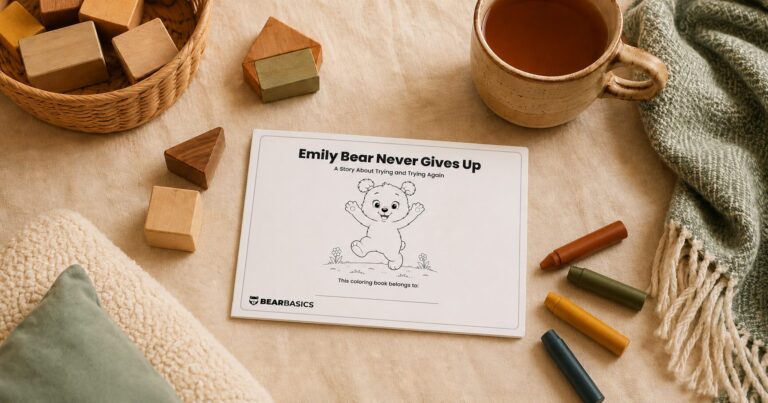
When a coloring page connects to a story — a character, a little narrative, a lesson — children get all the fine motor and focus benefits plus exposure to language, storytelling, and ideas. Coloring the character they just met in a story deepens their engagement with it, and talking about the story as they color builds vocabulary and comprehension. This is exactly the thinking behind our own Color & Grow storybooks — coloring pages woven into gentle stories, so the quiet developmental benefits of coloring travel alongside a story worth telling.
Story + coloring = language and imagination meeting fine motor and focus. It's a lovely, natural combination that makes an already-valuable activity richer still.
A few simple things help coloring deliver its quiet benefits:
Keep it joyful. The moment coloring becomes a test or a chore, its magic fades. Fun first — the development takes care of itself when a child is genuinely enjoying it.
In the spirit of honesty this whole post is built on, let's name the limits:
Coloring books are secretly powerful because they hide real developmental work inside simple fun. In one quiet, screen-free, low-cost activity, a child builds fine motor skills and pre-writing control, practices focus, calms and regulates, makes creative choices, learns colors and concepts, and enjoys the confidence of finishing something. Paired with a story, it adds language and literacy on top.
It's not magic and it won't replace everything else — but as underrated tools for young children go, a coloring book and a box of crayons is hard to beat. Keep it joyful and pressure-free, color alongside your cubs when you can, and let the quiet learning ride along inside the fun. If you'd like coloring woven into gentle stories, take a look at our Color & Grow storybooks.
Ian founded Bear Basics on one idea: personal care built from a short list of food-grade ingredients we all recognize. The Bear Basics den also makes gentle stories and coloring books for little ones. Read the full story →