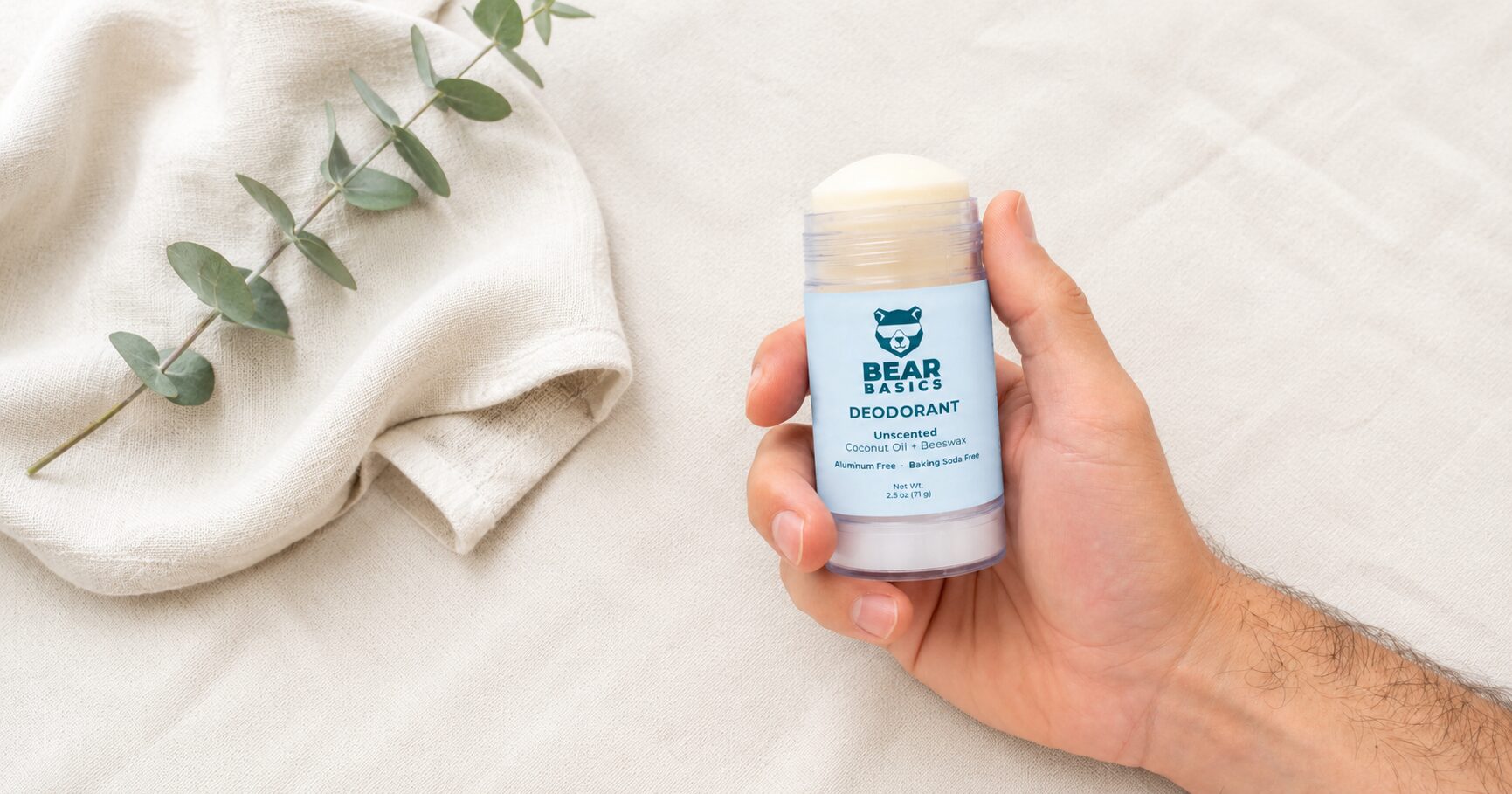
Quick answer
Natural deodorants can leave marks on clothes, and the good news is which kind: fresh oil-and-wax transfer — surplus balm meeting fabric — not the notorious yellow underarm staining associated with aluminum-based antiperspirant residue, whose chemistry natural formulas simply don’t contain. Prevention is two habits: one to two swipes per underarm (more adds transfer, not protection) and a one-to-two-minute pause before the shirt goes on. Removal is kitchen-grade: work dish soap or liquid detergent into the mark, wait fifteen minutes, wash warm per the care label, and air-dry until the spot is confirmed gone — heat drying is what sets oil marks, so it waits. Fresh marks release in one pass; even set-in ones surrender to a repeat.
Answers at a glance6 quick questions
Stains?
Oil transfer — washable, fixable.
Yellow stains?
Antiperspirant-era chemistry — not this.
Prevention?
Less product + 2-min pause.
Removal?
Dish-soap pre-treat, warm wash.
Dark shirts?
Same fix — air dry until clear.
The dryer?
Only after the mark’s gone — heat sets oil.
01 The short answer
Ask people why they hesitated before switching deodorants and laundry anxiety makes every list: “I heard natural deodorant wrecks your shirts.” It’s a fair worry with a genuinely reassuring answer — because it turns out the question contains two completely different problems wearing one name.
The marks natural deodorant can leave are oil transfer — a bit of fat-and-wax formula that met fabric before it finished settling into skin. Annoying, visible, and about as removable as stains get: it’s the same spot chemistry as a salad-dressing drip, and it answers to the same dish-soap treatment. The stain people actually fear — the permanent yellow underarm badge of ruined white shirts — belongs to a different product era entirely, and the ingredients behind it aren’t in a natural formula at all.
This playbook covers the whole subject: which mark is which, the two application habits that prevent nearly all of it, the removal protocol for fresh and set-in marks alike, and the honest formulation trade that explains why balm-style deodorants transfer in the first place. Your shirts are going to be fine — here’s the system.
02 Two different “stains” (know your enemy)
Everything in this article gets easier once you can tell the two “deodorant stains” apart, because they have different causes, different chemistry, and different fixes:
- Mark type one: fresh oil transfer. A translucent, slightly darkened patch (on darks) or faint greasy shadow (on lights) at the underarm or wherever product brushed fabric — appearing the same day you wore it. Cause: surplus balm-formula meeting cloth. Chemistry: fats and wax sitting on fibers. Fix: degreasing wash — sections 6–7. Prognosis: excellent.
- Mark type two: the yellow buildup. The stiff, yellowed underarm zone that develops on white shirts over weeks of wears and washes — the stain that gave deodorant its laundry reputation. It’s widely associated with the residue of aluminum-based antiperspirants interacting with sweat and fabric over time, building into that distinctive discoloration. Natural deodorants don’t contain aluminum salts — the chemistry that builds that particular stain isn’t in the stick.
Which yields this article’s most clarifying sentence: switching to natural deodorant trades a chronic staining chemistry for an acute, washable one — a slow one-way buildup for an occasional same-day spot that laundry handles. (If you’re mid-switch and comparing categories more broadly, the category explainer covers what else distinguishes them.) Now let’s make even the washable kind rare.
03 Why balm-style formulas transfer
Why do balm-style deodorants transfer at all? Because of exactly what they are — and regular readers can predict this section from the ingredient list:
- The formula is fats, wax, and mineral. Our deodorant is the balm architecture — tallow or coconut oil, beeswax, castor oil — carrying magnesium hydroxide, the odor-control ingredient. Fats and wax are precisely the substances that mark fabric when surplus meets cloth; the mineral itself rinses out harmlessly.
- It’s designed to glide and settle. The formula softens against skin on contact — the same near-body-temperature behavior as every balm we make — then settles in over a minute or two. During that settling window, the surface layer is available to anything that presses against it. A shirt, say.
- Transfer is surplus behavior. A thin layer settles fully and stays put; a thick layer leaves an unabsorbed surplus that never stops being available. Which is why the entire prevention story reduces to two habits — dose and timing — and why both fixes are free.
No mystery, no defect: a skin-temperature balm behaves like a skin-temperature balm. The next two sections turn that physics into shirt-safe habits.
04 Prevention fix #1: the dose
Prevention fix number one, responsible for most of the improvement most people need: use less. Genuinely less.
- The dose is one to two swipes per underarm. That’s the whole application — a thin, even film you can barely see. The odor-control work is done by contact and coverage, not by thickness; the mineral doesn’t work harder in a triple layer.
- Extra product is pure transfer inventory. Everything past the thin film is surplus that sits on the surface — adding zero protection and one hundred percent of the day’s marking potential. If you can see a thick white layer on skin, you’ve applied tomorrow’s laundry problem.
- The antiperspirant habit is the culprit. Years of gel and spray formats train a generous hand; balm formats want a light one. Most “natural deodorant ruined my shirt” stories are really “I applied it like my old product” stories — the same recalibration theme as the rest of the switching guide.
- Bonus: the stick lasts twice as long. Correct dosing halves consumption — the rare fix that saves shirts and money simultaneously.
Full application technique — warm-up swipe, coverage pattern, the works — lives in how to apply natural deodorant; today’s summary is one line: if your shirt keeps finding product, your skin was holding extra.
05 Prevention fix #2: the two-minute rule
Prevention fix number two closes the remaining gap: the two-minute rule — deodorant goes on first; the shirt goes on last.
- The settling window is real but short. Skin warmth takes the freshly applied film from “surface layer” to “settled in” within about one to two minutes. Fabric pressed on during that window wicks up the surface layer; fabric that arrives after meets settled product and takes essentially nothing.
- Sequence beats waiting. Nobody stands around timing their armpits — so don’t: reorder the routine instead. Deodorant right after drying off, then teeth, hair, whatever else — shirt last. The routine itself becomes the timer, the same habit-stacking trick from the kids’ routine guide, deployed on yourself.
- Dry skin helps too. Applying to fully towel-dried underarms lets the film settle as designed; product over lingering shower dampness sits looser, longer. (Damp skin is the rule for body balm; deodorant prefers the dry start — two products, two techniques.)
- Warm the first swipe on cold mornings. A rock-cold stick dispenses unevenly — thick where it catches — so give it a beat against skin to soften; the castor-oil glide does the rest.
Dose plus timing, honestly practiced, prevents the overwhelming majority of transfer — most people who adopt both never pre-treat a shirt again. For the marks that already exist: laundry time.
06 Removal: fresh marks
The removal playbook, fresh-mark edition — same-day spots, the common case:
01
Treat it as an oil spot — because it is one
Forget “deodorant stain” folklore; this is fat-and-wax on fiber, the exact species as a butter drip. Everything that follows is standard kitchen-oil doctrine, which is why it works so reliably. No specialty products required — your sink already stocks the MVP.
02
Pre-treat with a degreaser
A drop of dish soap — the grease-cutting workhorse — or liquid laundry detergent, worked gently into the mark with a fingertip or soft brush until it’s fully wetted. Let it sit 10–15 minutes; the surfactants need the dwell time to surround and lift the oils. Skip bar-soap scrubbing and hot-water rinsing at this stage — the pre-treat does the work.
03
Wash warm — per the care label
Launder in the warmest water the garment’s label allows; warmth helps release lifted oils, and the label keeps you from solving a spot by shrinking a shirt. Normal cycle, normal detergent — the pre-treat already did the targeting.
04
Air-dry until confirmed clear
The one rule that separates success from a permanent shadow: no machine drying until the mark is verifiably gone. Dryer heat sets residual oil into fabric — the point of no return. Check the spot dry; if a ghost remains, repeat the pre-treat and wash. Fresh marks almost always clear in one pass; the dryer is your victory lap, never your gamble.
07 Removal: set-in marks & buildup
For marks that rode through a dryer cycle, sat a season, or built up over many light transfers — the escalation ladder, mildest first:
- Round one: repeat with dwell. The standard pre-treat, but overnight — dish soap worked in, garment set aside, washed in the morning. Time substitutes for aggression surprisingly often.
- Round two: the paste. Baking soda plus a little dish soap into a paste, worked into the mark, 30–60 minutes, brush off, wash warm. The mild abrasive helps lift set residue from fiber surfaces without fabric damage.
- Round three: the vinegar soak. For waxy buildup and general underarm-zone stiffness: soak the area in a solution of white vinegar and warm water for an hour before the pre-treat-and-wash cycle. Vinegar softens residue films and refreshes fabric — the classic textile-care move for buildup of most kinds.
- Know the ceiling. A mark that survived multiple heat-set wash cycles may be permanent furniture — oil that’s been repeatedly baked in can pass the point of practical recovery. That’s the honest limit, and the reason section 6’s air-dry rule is the hill worth dying on.
Escalate patiently, one rung per wash, and most history comes out. And once your dose-and-timing habits are set, this section retires from your life entirely.
08 Fabric-by-fabric notes
Fabric notes, because underarms meet every textile eventually:
- Cotton & cotton blends — the forgiving majority: takes warm washes, tolerates the full escalation ladder, releases oil readily. The playbook as written.
- Synthetics (polyester, athletic wear) — release oil marks fine but hold odors more stubbornly in general (a fiber trait, not a deodorant verdict); wash promptly after wear, and the vinegar soak doubles as the odor refresh. Watch care labels on heat.
- Wool & delicates — gentle everything: diluted mild detergent, cool water, no vigorous working, no ladder past round one. When a favorite sweater is at stake, a professional cleaner beats a home experiment — cheap insurance.
- Silk — the professional’s category, full stop. Oil on silk is above this article’s pay grade, honestly.
- Performance/waterproof finishes — degreasers can affect technical coatings; follow the garment maker’s cleaning guidance over ours.
The meta-rule across all of them: the garment’s care label outranks this playbook — we’re experts in what the mark is; the label is the expert in what the fabric survives.
09 The white-shirt question, answered honestly
The white-shirt question deserves its own honest section, because it’s the fear underneath the whole topic: “Will my whites end up with the yellow armpits?”
- The yellow stain’s recipe requires an ingredient we don’t have. That distinctive stiff yellowing is widely associated with aluminum-based antiperspirant residue interacting with sweat and fabric across repeated wear-wash cycles. No aluminum salts, no that-particular-chemistry — a natural deodorant’s worst case on whites is the faint oil shadow this playbook removes.
- Whites show transfer soonest and forgive it most. A greasy shadow is more visible on white — and white cotton tolerates the strongest version of every fix: warmest washes, full escalation ladder, sunshine drying (sunlight is a gentle natural brightener with a long laundry pedigree).
- Shirts with a yellow past can try the ladder. Existing yellow buildup from previous products sometimes improves with the paste-and-vinegar rounds — results vary with how set it is, and no promises — but fresh whites entering a natural-deodorant era simply don’t accumulate it going forward.
Net honest answer for white-shirt wearers: the stain you’re afraid of is the one you’re leaving behind, and the one you’re trading into washes out. (What else changes when you switch, week by week: the transition guide.)
Want the free family bundle?Two Color & Grow coloring books, our Fam Jams family music, and a plain-English skincare guide — free. Grab the bundle — instant download. 10 Dark shirts & the residue question
Dark-shirt wearers have their own two-item complaint list, both easily retired:
- The wet-look patch — fresh oil transfer reads as a darkened, damp-looking zone on blacks and navies. Same mark, same fix: pre-treat, warm wash per label, air-dry until clear (a set shadow shows on dark fabric forever, so the no-dryer rule matters double here). Prevention’s dose-and-timing pair makes it rare.
- The white streak — the other dark-shirt nuisance: a visible chalky swipe where fabric dragged across freshly applied product. That’s surface residue (the mineral riding surplus balm), not a stain — it brushes off dry with a hand or lint brush, wipes away with a barely-damp cloth, and disappears from your life entirely once the one-to-two-swipe dose takes hold. Pulling shirts on carefully — stretching the collar rather than dragging the torso past the underarms — ends most streak encounters on its own.
Neither items’ chemistry differs from the rest of the article; dark fabric just runs a more dramatic highlight reel. Thin layer, two minutes, careful shirt entry: the black-tee wardrobe and the balm deodorant coexist peacefully ever after.
11 Troubleshooting: when marks keep happening
If marks persist after the dose-and-timing fixes, run the troubleshooting tree — each branch has a distinct signature:
- Still over-dosing without noticing? Test: after your two-minute settle, press a tissue flat against the underarm — heavy product pickup means surplus survives your current swipe count. Drop to a single swipe for a week and re-test.
- Stick softened by storage? A deodorant living somewhere warm dispenses thick and settles slow — the storage guide’s cool-dark-closed doctrine applies to the medicine cabinet too, and a proper re-set restores a heat-softened stick’s dispensing.
- Tight sleeves & compression fits? Constant fabric-on-skin pressure extends the transfer opportunity past any settling window. Extend the pause to a full two-plus minutes before those garments, and keep the layer thinnest on compression days.
- Reapplying mid-day onto worn skin? A gym-bag touch-up over the day’s accumulation doubles the surface load. Wipe or rinse first when possible, then the thin re-application — the not-working fixes guide covers the fuller mid-day protocol.
- All clear and still marking? Then something else in the routine is the oil source — body balm applied heavy right before dressing behaves identically at the underarm seam. Audit the whole pre-shirt sequence once; the culprit is usually surplus somewhere.
One signature, one fix — the tree resolves virtually every persistent case without drama.
12 The formulation trade we chose
Close with the honest engineering question: couldn’t we just formulate a zero-transfer natural deodorant? Here’s the trade as we weighed it — a familiar shape by now:
- Zero-transfer means a harder, drier stick — more wax, less fat, stiffer set: a formula that stays put on fabric by staying on top of skin, dragging across the most delicate real estate you shave. The glide that makes daily application comfortable — castor oil’s whole six percent, the fats’ skin-temperature softening — is precisely what a transfer-proof texture sacrifices.
- Or it means the synthetic route — silicones, volatile carriers, film-formers: the quick-dry entourage that conventional formats use, and that our five-ingredient label exists to decline.
- So we chose the two-minute deal: a formula gentle enough for daily underarm skin, honest enough to need a thin dose and a short pause, and washable when life skips the manual. Comfort every day, in exchange for a habit that costs nothing — the same asymmetric trade as the melt-point decision, made for the same reasons.
Every deodorant format sits somewhere on this triangle of glide, transfer, and ingredient list. We planted ours at the gentle-and-simple corner and wrote you the playbook for the rest — which is, you may have noticed, sort of our whole thing.
13 The bottom line
Do natural deodorants stain clothes? They can mark them — with the washable kind: same-day oil transfer that a dish-soap pre-treat and a warm wash clear, prevented almost entirely by two free habits (one-to-two swipes; shirt goes on last, two minutes later). The yellow underarm stain of laundry legend belongs to aluminum-era chemistry a natural stick doesn’t carry — that’s the stain you retire by switching, not the one you inherit.
Master the dose, build the pause into your routine’s sequence, guard the air-dry rule like it’s sacred (it is — heat sets oil), and the entire topic shrinks to a non-event: clean shirts, quiet underarms, and one more piece of natural-deodorant folklore filed where it belongs — solved.
"You’re trading a chronic stain chemistry for an acute washable one — a one-way yellow buildup for a spot that answers to dish soap."— The honest verdict
The 6 things to remember
- Natural-deodorant marks are oil transfer — washable; the yellow buildup is aluminum-era chemistry we don’t carry.
- Prevention: 1–2 swipes per underarm, and the shirt goes on last — two minutes after.
- Removal: dish-soap pre-treat, 15 minutes, warmest wash the care label allows.
- Air-dry until the mark is confirmed gone — dryer heat sets oil permanently.
- White streaks on darks are surface residue: brush off dry, and right-dosing retires them.
- Persistent marks = surplus somewhere: run the tissue test and the troubleshooting tree.
Frequently asked
Do natural deodorants stain clothes?
They can leave marks, but of a specific and fixable kind: fresh oil-and-wax transfer from the balm-style formula rubbing onto fabric — usually from applying too much or dressing too soon. It washes out with an ordinary degreasing pre-treat. This is a different phenomenon from the yellow underarm staining associated with aluminum-based antiperspirant residue, which natural deodorants don’t contain the ingredients to cause.
Why does my natural deodorant leave marks on shirts?
Two causes account for nearly all of it: dose (more than one or two swipes per underarm leaves surplus product sitting on skin, and surplus transfers) and timing (fabric pressed onto still-wet product picks it up). The fix is using less than you think and giving it a minute or two to settle before dressing.
How do I get natural deodorant stains out of clothes?
Treat them as what they are — oil marks: work a drop of dish soap or liquid laundry detergent into the spot, let it sit 10–15 minutes, then wash in the warmest water the garment’s care label allows. Check before machine-drying; heat sets any remaining oil, so repeat the pre-treat first if a shadow remains. Fresh marks usually release in one pass.
What causes yellow armpit stains on white shirts?
The classic yellow underarm stain is widely associated with the residue of aluminum-based antiperspirants interacting with sweat and fabric over repeated wears and washes. Natural deodorants don’t contain aluminum salts, so they don’t produce that chemistry — their marks are simple oil transfer, which behaves like any kitchen-oil spot in the wash.
How much natural deodorant should I apply?
One to two swipes per underarm — genuinely. A thin, even layer does the odor-control work; extra product doesn’t add protection, it just sits on the surface waiting to meet your shirt. If you can see a thick white layer on your skin, you’ve applied two or three doses.
Should I wait before getting dressed after applying deodorant?
Yes — about one to two minutes. The formula warms and settles into skin quickly; fabric pressed on immediately picks up the surface layer instead. Building the pause into your routine (deodorant first, then teeth, then shirt) removes the transfer window entirely.
Will natural deodorant marks come out of dark clothes?
Yes — dark fabrics show fresh oil marks more visibly (a darkened, wet-looking patch) but release them the same way: dish-soap pre-treat, warm wash, air dry until clear. White residue streaks on dark shirts, a different nuisance, brush off dry or wipe away with a damp cloth — and shrink to nothing once your dose is right.
Does magnesium hydroxide stain clothes?
No — magnesium hydroxide is a white mineral that rinses from fabric without binding or discoloring; any visible white streaking is surface residue that brushes or washes away. The transfer question in balm-style deodorants is about the fats and wax that carry the mineral, and those respond to the standard oil-mark treatment.
Megan Smith
Co-Founder, Bear Basics
Megan co-founded Bear Basics and leads design. As a mom, she writes our gentlest, most practical guides — on ingredients, sourcing, and simple family skincare — with an emphasis on honest, well-sourced, and simple. Read the full story →
Gentle on skin. Honest with shirts.Balm-style deodorant built for the thin-dose, two-minute routine — odor handled, laundry unbothered. Prefer Amazon? Find us there too.Shop deodorant