Quick answer
We build on the fewest ingredients that fully do the job — four in our balms — because every ingredient is a question your skin has to answer, and reactive skin answers fewer questions gracefully. Short lists are patch-testable in a way long ones aren’t, debuggable when something goes wrong, and honest by construction: nothing on the label is filler, fragrance, or a sealed box. The engineering that makes it possible is going water-free — no water means no preservative system, no emulsifiers, no stabilizer entourage. And the honest limits: short isn’t automatically better (sourcing and formulation still rule), and some jobs — lightweight lotions, specialized actives — genuinely need longer lists. For the essential jobs, though, four is enough. That’s the philosophy.
Answers at a glance6 quick questions
How few?
4 per balm, 5 in deodorant.
Why fewer?
Fewer variables = fewer reactions, real debugging.
Why are lotions long?
Water needs an entourage.
Long = bad?
No — just harder to vet.
Short = safe?
Safer odds, never a guarantee.
The test?
Every ingredient earns its line.
01 The short answer
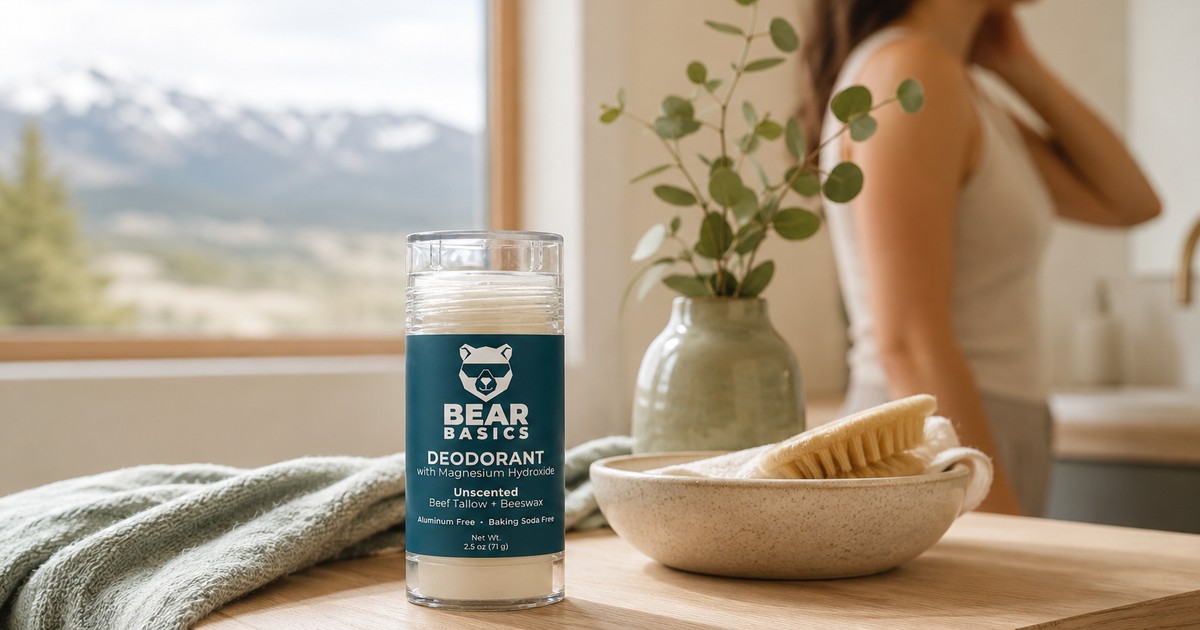
Flip over any product we make and the ingredient list fits in one breath: a base fat, beeswax, castor oil, vitamin E. The deodorant adds magnesium hydroxide and stops. No line you have to look up, no term that stands for twenty unnamed others, nothing whose honest job description is “makes the label look scientific.”
This week we’ve been showing the philosophy one decision at a time — why an ingredient stays, why a whole category goes. Today is the philosophy itself, argued in full: why fewer, what fewer actually buys you (the answer is mostly certainty), the structural trick that makes four ingredients sufficient, and — because this blog doesn’t do religion — the honest places where short lists stop being an advantage.
By the end, “short ingredient list” should stop being a vibe you trust and become a mechanism you understand — which, around here, is always the actual product.
02 How ingredient lists got long
First, fairness to the long lists: they didn’t happen because formulators love complexity. Ingredient lists grew for traceable reasons, and knowing them keeps this philosophy honest rather than smug:
- Water-based formats won the market. Lotions and creams feel light and absorb fast — consumers chose them — and water-based formulas structurally require a support crew (the full mechanics in section 6).
- Safety work takes ingredients. Preservation against microbes isn’t filler — in a water formula it’s the difference between skincare and a petri dish. Several lines of many labels are doing genuine protective duty.
- Marketing actives multiplied. Every trend adds a line — a botanical extract here, a trademarked complex there — often at percentages better described as “label decoration.”
- Fragrance and its fixers. The scent, plus the stabilizers the scent needs — the sealed box we opened in yesterday’s post.
Result: the modern default lotion runs thirty-plus lines — some structural, some protective, some decorative, indistinguishable at a glance. The problem was never that long lists exist; it’s that they’re unreadable — and unreadable is the thing we set out to fix.
03 Autopsy of a 30-ingredient lotion
To see what a short list removes, dissect what a typical long one contains. Take a representative thirty-ingredient body lotion and sort every line by its actual job:
- The base (1 line): water — usually the first and largest ingredient.
- The moisturizers (4–8 lines): the oils, butters, glycerin, and emollients — the part that serves your skin, often a modest share of the formula.
- The water’s entourage (8–15 lines): emulsifiers holding oil and water together, preservatives policing microbes, stabilizers, thickeners, pH adjusters, chelators — ingredients that serve the formula, not the skin.
- The experience layer (3–6 lines): fragrance, colorants, silicones for slip — ingredients that serve the sale.
- The label decoration (2–5 lines): trend extracts at trace percentages — ingredients that serve the marketing.
The takeaway from the autopsy
In a typical long formula, the minority of lines serve your skin; the majority serve the water, the sale, or the copy. That’s not scandal — it’s the water-based format’s honest cost of doing business. But it reframes the question beautifully: what if you only kept the lines that serve the skin? Keep pulling that thread and you arrive, more or less inevitably, at a four-ingredient balm.
04 Every ingredient is a question
Here’s the frame that turns ingredient counting from aesthetics into risk math: every ingredient in a product is a question your skin has to answer. “Do you tolerate this?” — asked once per line, every application, for as long as you use it.
- Most skin answers most questions fine. That’s why long-list products work for most people most of the time — worth saying plainly.
- Reactive skin flunks more questions — and a stressed barrier lets more of every ingredient through to deeper layers where reactions start, so the questions get harder exactly when skin is least equipped. The worse your skin week, the more each additional line costs.
- Sensitization is cumulative. Contact allergies are often acquired through repeat exposure — each additional ingredient across your whole routine is another lottery ticket you didn’t need to buy.
- The questions multiply across products. A five-product routine of thirty-line formulas asks skin ~150 questions a day. The same routine in short-list formats asks a couple dozen. Same jobs done; an order of magnitude fewer chances for one bad answer.
Four ingredients isn’t minimalism for its own sake — it’s asking your skin the fewest questions that still get the work done. And when skin does flunk one, the short list pays its biggest dividend of all, which deserves its own section.
05 Debuggability: the short-list superpower
Ask anyone who’s lived it: the misery of reactive skin isn’t just the reaction — it’s the not knowing what caused it. Something in the routine is the culprit; the routine is four products deep and a hundred ingredients wide; and dermatology’s honest advice — eliminate and reintroduce one variable at a time — becomes a months-long forensic project.
This is where short lists stop being a preference and become a superpower: debuggability.
- A four-ingredient product is a solvable puzzle. React to it, and your suspect list is four names long — three of which (the fat, the wax, castor) you can cross-reference against other products you tolerate. Most users can isolate a culprit in one thoughtful week.
- A thirty-ingredient product is a shrug. React to it and you learn almost nothing — the suspect list is the label. Multiply by a full routine and “my skin hates everything” becomes literally uninvestigable.
- Patch testing becomes meaningful. Testing a short-list product actually tests something specific; the ritual we attach to every product — ours included — only produces information when the list is short enough to interpret.
- Even doctors benefit. Show a dermatologist a four-line label and a reaction, and you’ve handed them a workable differential instead of a haystack.
We’d go as far as this: for sensitive-skin families, debuggability is the single most underrated product feature in skincare — invisible until the day it’s everything.
06 Water: the ingredient that invites the crowd
Now the engineering heart of the philosophy — because you can’t just delete twenty lines from a lotion and ship what’s left. The long list isn’t lazy; it’s load-bearing. The load is water.
- Water and oil don’t mix — so every cream needs emulsifiers, and usually several, holding the marriage together across temperature swings and shelf months.
- Water is life support for microbes — so every water formula needs a preservative system, tested and dosed, or it becomes a biology experiment. This is honest, necessary work; we’ll never mock a preservative doing its job in a water-based product.
- Water-based textures need management — thickeners, stabilizers, pH adjusters: the difference between a cream and a curdle.
Follow the logic to its clean conclusion: the entourage exists to serve the water — so remove the water, and the entourage has nothing to do. No emulsifiers (nothing to emulsify), no preservative system (nothing for microbes to drink), no stabilizer squad. What remains is fats, wax, and an antioxidant — a formula that is structurally incapable of needing a long list.
That removal has a name, and it’s the quiet foundation under everything we make.
07 The anhydrous shortcut
Anhydrous — water-free — is the format that makes the short-list philosophy physically possible rather than merely aspirational. We’ve profiled it fully in anhydrous skincare, explained; here’s its role in today’s argument:
- It deletes the entourage by construction. Every balm, bar, stick, and deodorant we make is 100% active-by-volume in the loose sense: fats doing emollient-occlusive work, wax doing structure, vitamin E guarding the fats. No line serves the water, because there isn’t any.
- It changes the one “preservative question” we do get: our products skip preservatives not through bravado but through biology — nothing to preserve against. The vitamin E is an antioxidant, a different job (protecting fats from oxygen, per its profile), and the distinction matters.
- It sets the trade honestly: anhydrous means rich, concentrated formats applied to damp skin — not the light, watery feel of a lotion. That’s a real preference fork, and the reason lotion-lovers aren’t wrong; they’re just buying the water and its staff.
One sentence to keep: we don’t have a short list because we’re restrained; we have a short list because we chose a format where nothing else was needed. Philosophy is cheap; format is what enforces it.
08 Where short lists have limits (honestly)
Now the section that keeps this from being a sermon. Short lists have real limits, and pretending otherwise would violate the philosophy’s own honesty clause:
- Short doesn’t vet sourcing. Four terrible ingredients make a terrible product with a lovely label. Rendering quality, refining grade, supplier standards — the themes of half this blog — matter more than the count. A short list makes quality checkable, not automatic.
- Some jobs need the crowd. Lightweight daytime hydration, specialized actives, sun protection — legitimately longer-list territory. Anyone whose dermatologist prescribed a thirty-ingredient cream should follow the dermatologist, not our label aesthetic.
- Short lists can be marketing too. “Only 5 ingredients!” is now itself a selling vibe — and a five-ingredient product whose five are cheap fillers is the old trick in new packaging. The count is a starting point for scrutiny, never a substitute for it (the greenwashing guide applies to minimalists with equal force).
- Nobody’s skin is guaranteed. Four questions is fewer, not zero — any ingredient can bother somebody, which is why the patch-test advice survives every paragraph of this philosophy.
Held with its limits, the claim is narrower and stronger: for the essential daily jobs, on the skin types that need care most, fewer well-chosen ingredients beat many — and the “well-chosen” is carrying half that sentence.
09 “Earns its place,” shown in practice
“Well-chosen” has an operational definition here, and regular readers watched it fire live this week: every ingredient earns its place, or loses it.
- The test: at the percentage used, does this ingredient do work the customer can feel — work we can name in one sentence without marketing vocabulary?
- The pass: castor oil at ~6% in the deodorant — glide on delicate skin, daily — earned its line, seed-oil discourse and all, as Monday’s post argued in public.
- The cut: the same castor oil at ~1% in one lip balm formula — a rounding error of glide — came off the label, shortening that formula to three. Same ingredient, same brand, opposite verdicts, one standard.
- The point: a philosophy that only ever justifies what’s already on the label is a press release. Ours has a body of work: things kept with reasons, things cut with reasons, and the reasons published either way.
This is also your best test of any “simple” brand, ours included: ask what they’ve ever removed, and why. A short list that’s never gotten shorter was probably designed by marketing; one with cut marks was designed by the test.
Want the free family bundle?Two Color & Grow coloring books, our Fam Jams family music, and a plain-English skincare guide — free. Grab the bundle — instant download. 10 Reading long lists without fear
A short-list philosophy done right should make you a better reader of long lists, not a fearful one. The charitable-but-sharp method, building on the label-reading guide:
- Sort by job, not by syllables. Unpronounceable ≠ sinister — tocopherol is vitamin E; cetearyl alcohol is a gentle emulsifier, not “alcohol” in the drying sense. Run the section-3 autopsy: base, moisturizers, entourage, experience, decoration.
- Respect the safety crew. Preservatives in a water formula are doing honest work — a “preservative-free” cream is the red flag, not the preserved one.
- Squint at the experience layer. Fragrance, dyes — the lines serving the sale are where sensitive skin’s risk concentrates, per yesterday’s argument.
- Discount the decoration. Trend extracts trailing the preservative in list position are present at trace levels — enjoy the poetry, ignore the promises.
- Then decide on the whole. A long list can absolutely earn a place on your shelf — it just has to earn it line by line, which is precisely the work a short list does for you in advance.
That last clause is the philosophy in miniature: short lists aren’t anti-long-list; they’re pre-audited. We did the sorting so the label wouldn’t need it.
11 The short-list household
Zoom out from the label to the bathroom shelf, and the philosophy compounds into household arithmetic — the practical payoffs families report when they simplify:
- One shelf serves everyone. Unscented, short-list, whole-family formats collapse his/hers/kids/baby into one shared lineup — fewer products purchased, stocked, and expired.
- New-member onboarding is trivial. A new baby, a visiting grandparent, a sensitive-skinned houseguest: the shelf already works, patch test and go — the logic of the minimalist baby kit extended to everyone.
- Reactions become solvable events — section 5’s debuggability, multiplied across a household’s worth of skin.
- The mental load drops. No re-vetting thirty lines every restock, no tracking which product whose skin vetoed — the quiet cost of complex routines that nobody bills you for but everybody pays.
If you want the guided version of that simplification, the 30-day simplify plan and the five highest-impact swaps are the on-ramps. The short-list philosophy was never really about labels — it’s about how much of your life a bathroom shelf is allowed to occupy. Our answer: one breath’s worth.
12 Our four, in one breath each
Closing the loop with the promised audit — our entire ingredient roster, one honest sentence each:
- Grass-fed beef tallow — the rich base fat whose fatty acids echo skin’s own; emollient and occlusive at once. (The case; the process.)
- Organic coconut oil — the lighter base fat for the line that prefers it; quick-spreading emollience with its own occlusive share. (Honest profile, rare-but-real allergy note included.)
- Beeswax — structure: why a balm is a stick, plus a light occlusive film; animal-derived and disclosed loudly. (The full reckoning.)
- Castor oil — glide and cushion at single-digit percentages; a seed oil, cold-pressed, and told so. (The journey.)
- Vitamin E — the antioxidant guarding the fats, not a preservative and not marketed as skincare magic. (The distinction.)
- Magnesium hydroxide (deodorant only) — the odor-control ingredient, named plainly. (Its profile.)
Six ingredients across the entire catalog, each with a published biography. That’s what “nothing to hide” looks like when it’s a filing system instead of a slogan.
13 The bottom line
The short-list philosophy, compressed to its load-bearing beams: every ingredient is a question your skin must answer, so ask the fewest that get the work done. Choose a water-free format so the label never needs the water’s entourage. Make every survivor earn its line — and publish the cuts. Grant the limits freely: short doesn’t vet sourcing, some jobs need longer lists, and no count guarantees any one person’s skin.
What’s left is a modest, defensible, deeply practical idea: for the daily essentials, on the skin that needs gentleness most, a one-breath label you can read, test, and trust beats thirty lines you have to take on faith. Four ingredients. Four jobs. One breath. That’s the whole philosophy — and the whole product.
"Short lists aren’t anti-long-list. They’re pre-audited — we did the sorting so the label wouldn’t need it."— The honest verdict
The 6 things to remember
- Every ingredient is a question your skin answers — short lists ask fewer, which matters most for reactive skin.
- Long lists exist mainly to serve water: emulsifiers, preservatives, stabilizers — necessary there, absent here.
- Anhydrous (water-free) format is what makes four ingredients structurally sufficient.
- Debuggability is the superpower: a four-line label makes reactions solvable and patch tests meaningful.
- Short isn’t automatically better — sourcing decides quality, and some jobs honestly need longer lists.
- “Earns its place” has teeth: castor kept at 6% in deodorant, cut at 1% from a lip balm. One standard.
Frequently asked
Why are fewer ingredients better in skincare?
Fewer ingredients means fewer variables: fewer chances for irritation on reactive skin, fewer unknowns to patch test, and — if something does bother you — a short enough suspect list to actually identify the culprit. It also tends to mean each ingredient is doing real, nameable work rather than filling a marketing checklist. It is not a guarantee of quality by itself; sourcing and formulation still decide that.
How many ingredients are in Bear Basics products?
Four in our core balms and bars: a base fat (grass-fed tallow or organic coconut oil), beeswax, castor oil, and vitamin E. Our deodorant adds one more — magnesium hydroxide — for odor control. Every ingredient has a job we can name in a sentence, and one formula runs shorter still after castor oil failed to earn its place there.
Why do regular lotions have 30+ ingredients?
Mostly because of water. Once a formula contains water, it needs emulsifiers to hold oil and water together, preservatives to stop microbial growth, stabilizers, pH adjusters, and texture agents — a support crew for the water before a single ingredient serves your skin. Add fragrance and marketing actives and lists grow past thirty fast. It’s engineering, not conspiracy — but it’s engineering you can opt out of.
Are long ingredient lists bad?
Not automatically. A well-formulated thirty-ingredient cream from a careful maker can be a fine product, and some of those ingredients are doing necessary safety work like preservation. The honest claims are narrower: long lists are harder to vet, harder to debug when skin reacts, and statistically more likely to include the common irritants like fragrance. Short lists trade capability for certainty.
What does ‘every ingredient earns its place’ mean?
It’s our formulation test: each ingredient must do work the customer can feel, at the percentage used, or it comes off the label — whatever its reputation. We’ve applied it against our own formulas, including removing castor oil from one lip balm recipe where, at about one percent, it had stopped doing meaningful work. A standard that never cuts anything is a slogan.
Is a short ingredient list safer for sensitive skin?
Generally, yes — in the probabilistic sense. Reactive skin tolerates fewer variables, and a four-ingredient product asks four questions instead of thirty. But no ingredient count guarantees anyone’s skin tolerates a product: any substance can bother somebody. Short lists make patch testing meaningful and reactions diagnosable; they don’t make them impossible.
How can water-free products skip preservatives?
Preservatives exist to control microbial growth, and microbes need water. Anhydrous (water-free) formulas — pure fats, oils, and wax — give bacteria and mold nothing to live in, so they don’t need a preservative system. They still use an antioxidant (our vitamin E) to keep the fats themselves from oxidizing, which is a different job.
Do fewer ingredients mean weaker products?
For the jobs balms do — moisturizing, sealing, smoothing, odor control — no; fats, wax, and magnesium hydroxide cover those jobs completely. Fewer ingredients does mean fewer capabilities: no lightweight water-based feel, no specialized actives. A short-list balm is a master of a few essential trades rather than a jack of thirty.
Megan Smith
Co-Founder, Bear Basics
Megan co-founded Bear Basics and leads design. As a mom, she writes our gentlest, most practical guides — on ingredients, sourcing, and simple family skincare — with an emphasis on honest, well-sourced, and simple. Read the full story →
One breath. The whole label.Four-ingredient balms, five-ingredient deodorant — every line with a published biography. Prefer Amazon? Find us there too.Shop the line