Spend $50, Get 10% Off

Most kids don’t need deodorant until they’re heading into puberty — and when they do, gentle and low-drama wins. Wash first, choose a simple baking soda–free formula, patch test, and make it a normal, private part of the routine.

Most kids don’t need deodorant until they start heading into puberty — often somewhere between about 8 and 13, though it varies a lot from child to child. The first and most effective step is simply washing the underarms with soap and water every day. When odor does begin, a gentle, baking soda–free natural deodorant — one that controls odor rather than trying to block sweat — is a reasonable, low-pressure choice. Always patch test on a small area first, and check with your pediatrician if odor starts unusually early or comes alongside other changes.
The honest answer is: usually not for a while, and then eventually yes — but on their own timeline. Young children simply don’t produce much body odor. The sweat glands most responsible for the smell we associate with adult underarms don’t become very active until the body starts moving toward puberty. Before that point, a bath and clean clothes handle almost everything.
So a young child who ran around all afternoon and smells a little sweaty is almost always a washing question, not a deodorant question. Reaching for a product too early adds a step nobody needs.
Where it shifts is the tween years. As hormones change, the underarm environment changes with them, and a light deodorant starts to earn its place. The goal isn’t to make a child feel like something’s wrong — it’s to give them a simple tool for comfort and confidence as they grow. Think of it like a toothbrush: an ordinary part of taking care of yourself, not a fix for a problem.
Little kids: washing is plenty. Tweens heading into puberty: a gentle deodorant becomes a reasonable, everyday habit.
Body odor tends to arrive as a child approaches puberty, which for many kids lands somewhere in the range of about 8 to 13 — but the spread is enormous and completely normal. Some kids notice it earlier, some much later. The number that matters is your child’s development, not the calendar.
Here’s the mechanism, in plain terms. Underarms have a type of sweat gland that becomes active around puberty. The sweat these glands produce isn’t smelly on its own. The odor appears when the normal bacteria that live on skin break that sweat down. More active glands plus warmth plus bacteria equals the familiar end-of-day smell.
That’s genuinely useful to know, because it explains why a fresh shower doesn’t last all day, and why the answer isn’t scrubbing harder. It also explains why a deodorant helps: it works with clean skin to slow odor as the day goes on, rather than trying to stop a normal, healthy process.
If strong body odor shows up unusually early — well before age 8 — or arrives suddenly alongside other early signs of puberty, that’s worth a quick, reassuring conversation with your pediatrician rather than a new product.
Before any deodorant enters the picture, the most effective habit is daily underarm washing with ordinary soap and water. It sounds too simple, but plenty of tweens who “need stronger deodorant” just need a more reliable morning wash. Washing removes the sweat and much of the odor-causing bacteria that built up, so deodorant has a clean surface to work on.
A realistic routine for a tween looks like this: a proper wash of the underarms in the morning shower, dry off well, and apply deodorant to clean, dry skin. On a hot or active day, a quick rinse and reapply after sports can do more than any “extra strength” anything.
None of this is glamorous, but it’s the foundation. Deodorant is the finishing touch on a clean start — not a substitute for it.
“Natural” is a word with no strict legal definition, so it’s worth being clear about what you’re actually choosing. For a kid, the practical meaning is simple: a deodorant with a short, recognizable ingredient list that focuses on odor control and skin comfort, without heavy synthetic fragrance or harsh actives.
A typical gentle formula uses a nourishing base — something like coconut oil or a plant butter, plus a wax to hold the stick together — along with an odor-controlling ingredient such as magnesium hydroxide. That’s it. No long list of things you can’t pronounce, and nothing designed to stop sweat.
The appeal for young skin is exactly that shortness. Fewer ingredients means fewer things that can irritate, and it’s easier to pinpoint a culprit if a reaction ever happens. It also makes it easy to check the label as a parent and actually understand what’s going on your child.
This distinction trips up a lot of parents, so it’s worth slowing down on. They are two different categories.
For the vast majority of kids and tweens, a plain deodorant is all that’s needed. The concern at this age is usually smell, not sweat volume, and odor control handles smell nicely without asking a growing body to do anything different.
On the aluminum question: there is no strong scientific evidence that aluminum in antiperspirants is harmful. At the same time, plenty of families simply prefer to keep things minimal and skip it — a valid preference, not a health verdict. If a tween genuinely struggles with heavy sweating that bothers them, that’s worth raising with a pediatrician rather than solving alone.
If you want to go deeper on the two categories, our comparison of natural deodorant vs. antiperspirant lays out the differences in more detail.
Kids’ underarm skin is thinner and more reactive than adult skin, so the bar for “gentle” is a little higher. You don’t need a chemistry degree to shop well — a few simple rules cover most of it.
Fragrance is the most common irritant to watch. A strong scent can smell great in the store and still bother sensitive skin — often the reason a “natural” product doesn’t agree with a child. Unscented options remove that variable entirely, which is why many families default to them. Beyond that, shorter really is better: every ingredient you remove is one fewer thing that could react on skin that’s still figuring itself out.
Baking soda is a genuinely effective odor fighter, which is why it shows up in so many natural deodorants. The catch is that it’s alkaline — higher on the pH scale than skin’s slightly acidic surface. For some people, and especially on the delicate skin under a young arm, that mismatch can lead to redness, stinging, or a rash after a few days of use.
It doesn’t happen to everyone. But when a kid tries a natural deodorant and complains that it burns or itches, baking soda is one of the first suspects — and that can sour a child on the whole idea when the real culprit was one ingredient.
Baking soda–free formulas sidestep that. Many use magnesium hydroxide instead — a gentle mineral that helps neutralize odor without the same irritation risk for most people. For a first deodorant on sensitive tween skin, that’s usually the smarter starting point.
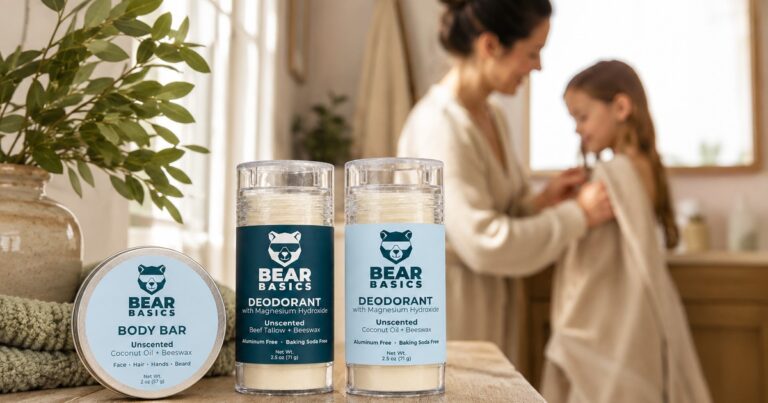
Our own deodorant is baking soda–free and leans on magnesium hydroxide for exactly this reason — it keeps the odor control while lowering the irritation risk on sensitive skin. You can read more about magnesium hydroxide in deodorant if you want the full picture.
Before a new deodorant becomes a daily habit, do a quick patch test. It takes almost no effort and can save you a miserable, itchy day at school.
Here’s the simple version: apply a small amount to a patch of skin on the inner forearm — not the underarm yet — and leave it for about 24 hours. Check for redness, itching, bumps, or any complaint of stinging. If the skin stays happy, you can move to the underarm with reasonable confidence.
Patch testing matters more for kids precisely because their skin is more reactive and because a young child may not flag mild irritation until it’s uncomfortable. A calm 24-hour test on the arm turns “let’s find out the hard way” into “we already know this is fine.” It’s a small step that makes the whole switch smoother.
The social side of this can be trickier than the product side. A lot of tweens feel self-conscious the moment a parent mentions body odor, so how you bring it up matters as much as what you hand them.
The tone that tends to land is matter-of-fact and normalizing. Frame deodorant as an ordinary part of growing up that everyone goes through — like a bigger shoe size or braces. Keep it one-on-one, never in front of siblings, and focus on the routine rather than the smell. “Your body’s starting to change, so here’s a new step for your morning” lands far better than any comment about odor.
Then hand ownership over. Let them keep the stick in their own bag and apply it themselves. Kids take pride in handling their own care, and a deodorant they control feels like independence rather than a correction.
Even gentle joking about a child’s smell can make them dread the whole routine. Keep humor out of this one — warmth and normalcy do the work.
A deodorant only helps if it actually gets used, and new habits stick best when they’re attached to something already automatic. For most tweens, that anchor is the morning routine: shower, dry off, deodorant, dressed. Slotting it right after drying keeps it from being forgotten.
Application is easy to over-complicate. A light layer — a couple of swipes on each clean, dry underarm — is enough. Caking it on doesn’t work better and can leave residue on clothes. Consistency beats intensity: a modest amount every morning on clean skin outperforms a heavy layer over an unwashed underarm, and a quick reapply after sports is a normal top-up, not a sign the product failed.
When a natural deodorant seems to underperform, it’s rarely a lost cause — usually one of a few fixable things is going on. Run through these before giving up.
First, the wash. If it’s going on over skin that wasn’t properly cleaned, it’s starting behind. Second, the amount and the skin: deodorant grips best on clean, dry underarms, so a damp application right out of the shower fades faster. Third, timing: many families switching from an antiperspirant find there’s a short adjustment period of a week or two while the underarm settles into just odor control instead of blocked sweat.
If you’ve worked through all of that and odor is still a daily battle, our guide to natural deodorant not working covers more troubleshooting, and the week-by-week switching guide walks through what a normal adjustment period looks like.
Most of the time, a tween needing deodorant is just an ordinary milestone that doesn’t require a doctor at all. But there are a handful of situations where a quick check-in is the right move, and knowing them lets you relax about everything else.
Reach out to your pediatrician if body odor appears unusually early — noticeably before age 8 — or if it’s very strong and sudden, particularly if it shows up alongside other early signs of puberty. Those aren’t emergencies, but a doctor can make sure development is on a normal track and put your mind at ease.
Also loop in your pediatrician if any deodorant causes a rash that doesn’t clear after you stop, if your child has a skin condition like eczema near the underarms, or if heavy sweating itself distresses your child. A deodorant is for comfort and confidence — it isn’t a treatment for a medical condition, and anything that looks medical deserves a professional eye.
Outside of those specific flags, a tween reaching for deodorant is simply a normal part of growing up — not a problem to solve.
Pulling it together, the whole thing fits on a sticky note. You don’t need a cabinet of products or a big talk — you need a clean start, a gentle stick, and a calm attitude.
Wash the underarms daily. Dry well. Apply a light layer of a simple, baking soda–free deodorant to clean, dry skin. Patch test anything new before it goes into rotation. Reapply after sports on tough days. And treat the whole routine as an ordinary, private part of growing up that your child gets to own.
That’s genuinely it. The tween years bring plenty of complicated moments; this doesn’t have to be one of them. A short ingredient list, a gentle formula, and a matter-of-fact tone turn deodorant into the small, confidence-building habit it should be. If you like keeping the rest of the family’s care equally simple, our guide to simple skincare for the whole family follows the same low-fuss philosophy.
Megan co-founded Bear Basics and leads design. As a mom, she writes our gentlest, most practical guides — on ingredients, sourcing, and simple family skincare — with an emphasis on honest, well-sourced, and simple. Read the full story →