Spend $50, Get 10% Off

It's the quiet, structural ingredient doing real work in nearly every balm you own. Here's what beeswax is, what it does, how to recognize it on any label, and the one or two people who should skip it.

Beeswax is the natural wax honeybees make to build honeycomb, and in skincare it gives balms their solid structure and helps seal moisture into the skin. On an ingredient label it appears as Cera Alba. It's gentle, widely considered low-comedogenic, and well tolerated by most people. The two exceptions are vegans — it's an animal product — and the rare person with a bee-product allergy, who'll want a plant-wax balm instead.
Open almost any lip balm, salve, or lotion bar and beeswax is probably in there, usually near the top of the list. It rarely gets attention — it's not a trendy "active" ingredient with a marketing budget — but it's doing two essential jobs quietly in the background: it gives the product its solid, swipeable form, and it helps hold a protective layer of moisture against your skin.
If you take nothing else from this guide: beeswax is a simple, natural, time-tested ingredient that most people tolerate beautifully. It's not a miracle cure and it doesn't "heal" anything — it's a supportive, structural ingredient. But for dry lips, rough patches, and cracked hands, that structure and seal are genuinely useful. Below we'll cover exactly what it is, what it does, how to spot it on a label, how it compares to plant waxes, the myths worth clearing up, and who should reach for something else.
Beeswax is exactly what it sounds like: the wax honeybees secrete to build the honeycomb inside their hive. Worker bees produce it from special glands, and it's the material that holds the whole structure of the comb together — storing honey, housing larvae, keeping everything organized.
For skincare, beekeepers collect the wax, and it's gently melted and filtered to remove debris. What's left is a clean, natural wax that's been used in balms and salves for thousands of years — long before the personal-care industry existed. That long track record is part of the appeal: it's not a novel synthetic that we're still learning about. It's one of the oldest cosmetic ingredients there is, and it's earned its place through sheer usefulness.
Chemically, beeswax is a blend of fatty acids, long-chain alcohols, and esters. You don't need to memorize that — the practical point is that this mix is what gives beeswax its firm-but-workable texture and its ability to form a breathable protective film. It's solid at room temperature and softens with body heat, which is exactly what you want in a balm you rub between your fingers before applying.
That temperature behavior is quietly important. A balm needs to stay solid in the jar and in your bag, then melt just enough on contact to spread in a thin, even layer. Too soft and it turns to a greasy puddle in a warm car; too hard and it drags across your lips. Beeswax hits a natural middle that's hard to beat, which is a big reason it has survived thousands of years of use while countless trendier ingredients have come and gone.
This is where a lot of people get tripped up, because beeswax hides behind a Latin name on many labels.
Cera Alba is the standardized INCI name for beeswax ("cera" is Latin for wax). Some labels write it plainly as "beeswax," some use "Cera Alba," and some list both. Yellow beeswax is sometimes written "Cera Flava." They're all the same core ingredient.
Why the Latin? INCI — the International Nomenclature of Cosmetic Ingredients — is a global naming standard so the same ingredient reads the same way on a label in any country. It's useful once you know it, but it does mean a simple, natural ingredient can look intimidating. If you'd like the full method for decoding any ingredient list, start with how to read a skincare ingredient label.
Quick tip: if you see Cera Alba (or Cera Flava) high in a balm's ingredient list, you've found the wax that's giving that product its structure. If instead you see candelilla or carnauba, the product is using a plant wax — often a sign it's formulated to be vegan.
Beeswax pulls double duty, and understanding both jobs makes it obvious why it's everywhere:
A common worry is that beeswax "suffocates" skin. It doesn't. Its film is breathable — it slows moisture loss without sealing the skin like plastic wrap. That balance is exactly what makes it good for daily use.
There are plenty of ways to thicken a product. So why beeswax specifically? Because it lets a maker keep the ingredient list short and honest.
One natural wax delivers structure, a pleasant glide, and a moisture seal all at once. Without it, a formulator often needs a stack of synthetic thickeners, film-formers, and stabilizers to achieve the same feel. For a brand built on the idea of a short list of food-grade ingredients you can actually recognize, that's the whole point: one ingredient your grandmother would recognize, doing several jobs, instead of five you'd need to look up.
Every ingredient in a Bear Basics product has to earn its place. Beeswax earns it easily — it does structural and protective work that would otherwise take several synthetic ingredients to replicate.
It also melts and blends predictably, sets to a consistent texture, and has a mild, honey-adjacent character that plays well with everything from tallow to coconut oil. It's a workhorse, plain and simple.
For the large majority of people, yes. It's gentle, non-stripping, and it helps hold moisture where you want it. It's especially at home on the parts of you that get dry and exposed — lips, cheeks, hands, cuticles.
Let's be honest about what it isn't, though. Beeswax is not an "active" that transforms your skin, and it doesn't heal wounds or cure conditions — anyone claiming that is overselling. Its value is protective and supportive: it seals in moisture and shields against the elements. For chapped lips in January or wind-burned cheeks after a hike, that protective role is exactly what dry skin is asking for, and it's plenty.
It also pairs beautifully with moisturizing oils and butters. Beeswax provides the seal; the oils provide the nourishment. Together they're the backbone of a good balm — which is why you'll almost never see one without the other.
Anytime an oil or wax goes near the face, someone asks: will it clog my pores? Fair question. Here's the honest, useful answer.
Comedogenic is a 0–5 score for how likely an ingredient is to clog pores (0 = won't, 5 = very likely). Beeswax sits low on that scale for most people. Remember the scores rate the pure ingredient, not the finished product, and no official body governs them — so treat them as a rough guide, not a verdict. More in Comedogenic Ratings: Do They Actually Matter?
Practically: most people use beeswax balms on lips and body with zero issue. If you're very acne-prone and want to use a beeswax product on your face, patch-test a small area for a few days first. But for the overwhelming majority, beeswax is a low-risk, well-tolerated ingredient.
It's also worth separating the wax from the whole product. A balm is beeswax plus oils and butters, and how the finished product behaves on your skin depends on that entire recipe — not on the wax's number on a chart. A light, well-balanced beeswax lip balm behaves very differently from a heavy, oil-drenched one, even though both contain the same wax. This is exactly why comedogenic scores of single ingredients only tell you so much, and why patch-testing the actual product always beats worrying about a rating in the abstract.
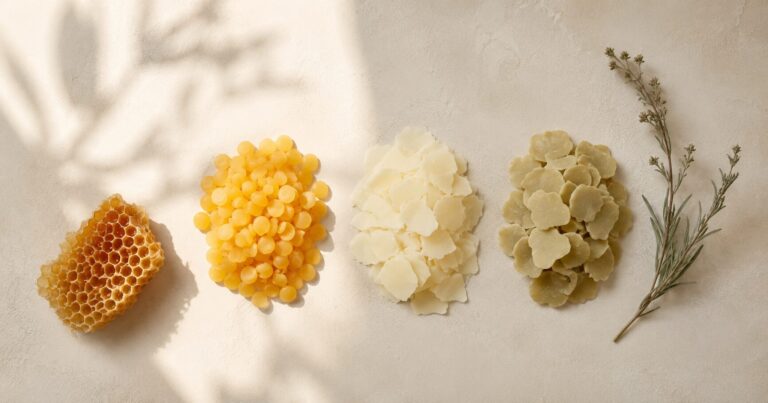
You'll see both on the market, and the difference is smaller than it looks:
Functionally they behave the same in a formula — both give structure and a moisture seal. The choice comes down to whether a maker wants a faint natural honey note and golden tint (yellow) or a neutral, scent-free base to build on (white). Neither is "better"; it's a formulation preference.
One small consideration for fragrance-sensitive folks: yellow beeswax's faint honey scent is natural and usually mild, but if you're building a truly scent-free routine, a white-beeswax product gives you a more neutral starting point. Neither contains added fragrance on its own, which is one of the things that makes a simple beeswax balm such a friendly choice for people who react to perfumed products.
Beeswax isn't the only wax that can give a balm its structure. The main alternatives are plant-derived, and they're the go-to when a product needs to be vegan.
| Wax | Source | Vegan | Feel |
|---|---|---|---|
| Beeswax (Cera Alba) | Honeybees | No | Soft, cushioned seal |
| Candelilla | Candelilla shrub | Yes | Firmer, glossy |
| Carnauba | Carnauba palm | Yes | Very hard, high-shine |
Candelilla and carnauba can absolutely give structure, but they're harder waxes, so formulators use less and often tweak the oils to keep the feel soft. Many people find beeswax gives the most cushioned, forgiving feel of the three — but if you need vegan, plant waxes do the job well. For a deeper comparison, see beeswax vs candelilla vs carnauba.
A few things get repeated online that are worth correcting:
The theme across all four: beeswax is simpler and gentler than the internet sometimes makes it sound. A short, honest label tells you what job each ingredient is actually doing, and beeswax's job is structure and seal — nothing sinister.
Myths like these tend to spread because a scary-sounding claim travels faster than a boring accurate one. "This natural wax gives your balm structure" doesn't get many clicks; "this ingredient is suffocating your skin" does. That's worth keeping in mind whenever you read about any ingredient — including the ones we use. The antidote is the same every time: look at what the ingredient actually does, check a credible source, and be suspicious of anything designed mainly to alarm you.
Beeswax suits most people, but not everyone. Two groups should reach for a plant-wax alternative:
you're vegan (beeswax is an animal product) or you have a known bee-product allergy. In both cases, look for candelilla or carnauba on the label instead. If you're simply unsure whether you react, patch-test a small area first.
That's genuinely the whole list. For everyone else — including sensitive and, usually, acne-prone skin — beeswax is a low-risk, well-tolerated ingredient with a very long safety history.
One more angle people care about: sourcing and sustainability. Beeswax is a renewable byproduct of beekeeping — bees produce it as part of their normal life in the hive, and responsible beekeepers harvest it without harming the colony. Supporting good beekeeping can even be a small net positive for pollinators, which matter far beyond skincare.
As always, the details depend on the beekeeper. The same short-label logic applies here as everywhere: a maker who's proud of their sourcing usually says so. If beeswax's origin matters to you, it's a fair thing to ask a brand about — and a good brand will have an answer.
We use beeswax to give our balms their structure and moisture seal — it's a natural fit for the short, recognizable ingredient lists we build around. You'll see it on our lip care labels as one of just a few ingredients, working alongside our hero bases of grass-fed tallow and cold-pressed coconut oil.
That combination is deliberate: the oils and tallow nourish and cushion, and the beeswax holds it all together and seals it in. It's the difference between an oil that runs off and a balm that stays put and protects. If you've ever wondered why our lip balm feels solid and protective rather than greasy, beeswax is a big part of the answer.
Beeswax is one of the oldest, simplest, and most useful ingredients in personal care. It's the natural wax bees make to build honeycomb; in your skincare it gives balms their form and helps seal moisture into your skin. On a label it reads as Cera Alba. It's gentle, widely considered low-comedogenic, and well tolerated — with vegans and the rare bee-allergic person being the two groups who'll want a plant-wax alternative.
In short: when you see beeswax on an ingredient list, that's not filler or a red flag. It's a natural ingredient earning its place by doing real, structural work — exactly the kind of short-list thinking we build everything around. Browse our lip care to see it in action.
Ian founded Bear Basics on one idea: personal care built from a short list of food-grade ingredients we all recognize. Everything is small-batch and made in Colorado. Read the full story →