Quick answer
A new product starts with a gap worth filling and an honesty test — whether we could explain every ingredient in a sentence — and then goes through small bench batches where most versions are bad on purpose, because finding failures early is cheap. Promising versions get changed one variable at a time, then put through stability testing: room temperature, elevated heat, and repeated freeze-thaw cycles over weeks, to find the problems that only appear with time. After that comes the unglamorous half — packaging, filling equipment, labelling, and compliance — and finally the decision nobody enjoys: whether the result is genuinely better than not making it. Plenty of formulas fail that last test while being perfectly safe. We don’t announce things before they clear it, because pre-selling something puts pressure on exactly the decision that should stay free.
Answers at a glance6 quick questions
Hardest part?
Not the mixing — the testing.
Bench batch?
Small trial runs, mostly failures.
Stability test?
Heat, freeze-thaw, weeks of it.
How long?
Months — sequentially, not in parallel.
Why no teasers?
It pressures the go/no-go call.
Ideas die?
Often — and quietly.
01 The short answer
We’ve spent this month writing about ingredients we’re studying — colloidal oatmeal, magnesium, hypochlorous acid, glycerin — and repeating the same line each time: nothing is finished, and we don’t pre-sell. It seems only fair to explain what “not finished” actually involves.
The mixing is the easy part. Anyone can melt fats and wax together, and anyone with a stick blender can make something cream-like. What takes months is everything after: making it the same every time, finding out whether it survives a hot truck in July, sourcing packaging that fits, meeting labelling requirements, and then deciding whether the result is genuinely better than not bothering.
So this is the process as we actually run it, at our scale, including the parts that go wrong. It’s also the most direct answer we can give to a question we get regularly — when is the cream coming? — which is: when it clears step eight, and not before.
02 Step 1: the gap
Products start with a gap, and gaps come from a few places:
- Customers asking for something we don’t make. The most reliable source, and the one we weight heaviest — particularly when the same request arrives repeatedly and in the same words.
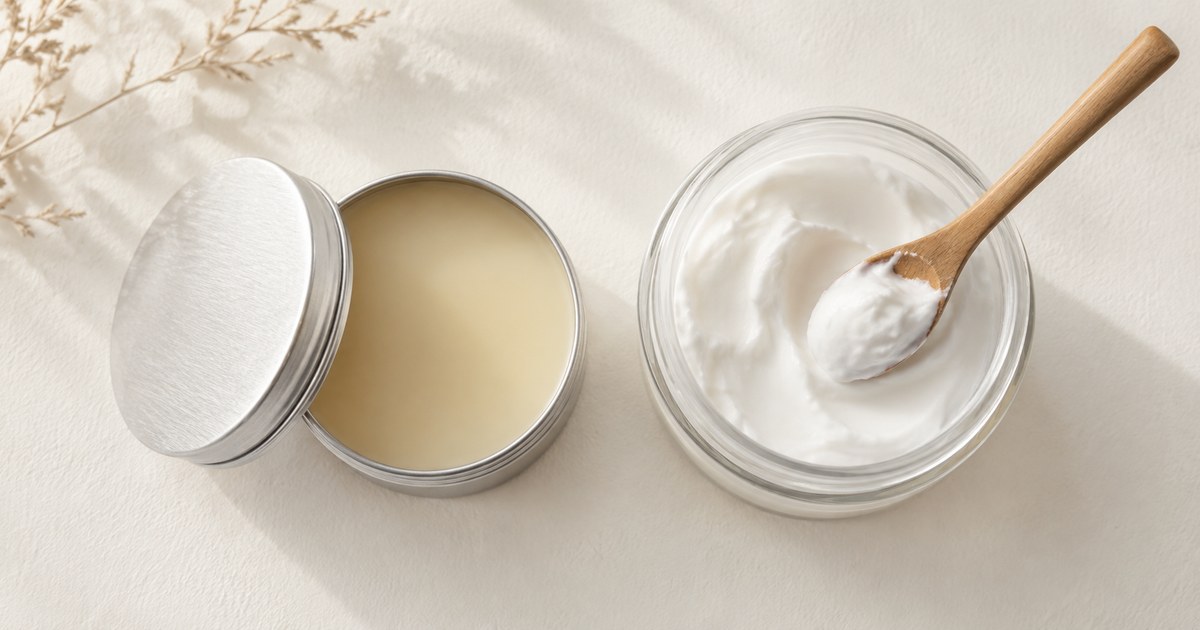
- A format limitation we can see in our own line. Our balms can’t give a light everyday feel or cover a whole body quickly, and they can’t carry water-soluble ingredients — the honest limits we set out in the balm versus cream comparison. Those are real gaps, not imagined ones.
- Something missing from the market that we’d want ourselves — which is how this brand started in the first place.
- And a gap is not the same as an opportunity. Plenty of things sell well that we wouldn’t want to make; plenty of things we’d like to exist can’t be made properly at our scale. The gap only gets you to step two.
The question we ask first
Not “would this sell?” but “does this need to exist?” There are already a great many moisturizers in the world. Adding another one is only worth doing if it’s meaningfully different or meaningfully better for someone — and “our logo on it” isn’t a difference.
03 Step 2: the honesty test
The filter that kills most ideas, and the one that defines this brand:
- Could we explain every ingredient in a sentence? Not “is it natural” — whether we could tell you what each one is doing and why it’s there. That’s the standard from the short-list philosophy, and it’s the one that does the actual work.
- Could we make the claims honestly? Some products only make sense if you’re willing to say things the evidence doesn’t support. We looked hard at this with topical magnesium, where the central claim is contested — and concluded that if we made something there, it would have to be sold on what it is rather than on physiological promises.
- Could we make it consistently at our scale? An ingredient like hypochlorous acid degrades invisibly with heat, light, and time. Making it is one thing; guaranteeing what reaches a customer in August is another, and that’s a genuine constraint rather than a formality.
- Would we use it on our own family? The least rigorous test on this list and the one that’s stopped the most ideas.
Ideas that fail here don’t reach a bench batch. Which means most of our product development happens in conversation rather than in a pot — and that’s the cheapest possible place for something to fail.
04 Step 3: bench batches
Then the actual making starts, at deliberately small scale:
- A bench batch is a trial run — a few hundred grams, made to test an idea rather than to sell. Cheap enough to throw away, which is important, because most of them get thrown away.
- You make variants, not a version. Several formulas differing in specific ways — different ratios, different base fats, different percentages — so you have something to compare against rather than a single result you can only judge in isolation.
- Most bench batches are bad, and that’s the point. Too greasy, too stiff, wrong absorption, unpleasant drag, separating within a day. Finding failures at this scale costs an afternoon and a few dollars of materials; finding them after a production run costs a great deal more.
- Everything gets written down. Exact quantities, temperatures, order of addition, cooling method — because a good result you can’t reproduce is worthless, and the difference between two batches is often something you’d never think to record.
- And you wait before judging. A balm that feels perfect the day it’s poured can be grainy in a fortnight, for the fat-crystal reasons behind the melt-and-reset problem. Fresh impressions are unreliable.
05 Step 4: changing one thing at a time
The discipline that turns tinkering into development:
- One variable per batch. Change the wax percentage or the base fat or the cooling method — never two at once, because then you can’t attribute the difference to anything. Slow, and the only way to actually learn something.
- It’s the same logic we give customers for identifying what bothers their skin: simplify, then reintroduce one thing at a time, as in the sensitive skin guide. Debuggability applies to making products as much as to using them.
- Small changes have big effects. A percentage point of wax changes how a balm sets. A slightly different cooling rate changes texture entirely. This is why “it’s just four ingredients” understates the difficulty — the ingredient list is short and the parameter space isn’t.
- Other people have to try it. The person who made a formula is the worst judge of it. Different skin, different climates, different expectations — and honest feedback specifically from people willing to say something is unpleasant.
- And you have to be willing to go backwards. Sometimes the fourth iteration is worse than the second, and the right move is returning to the second rather than defending the work.
06 Step 5: stability testing
The stage that catches what a fresh sample never shows:
01
Room temperature, over weeks
The baseline: does it hold its texture, colour, and smell under normal storage? Checked repeatedly over time rather than once, because slow changes are exactly the ones you’d otherwise ship.
02
Elevated heat
Held at high temperature to accelerate ageing and simulate the worst realistic conditions — a delivery truck in July, a mailbox in August. This is where separation, texture collapse, and rancidity show up early, and it’s the test our formats most need to pass given how much we write about heat and storage.
03
Freeze-thaw cycles
Frozen and returned to room temperature several times over. Winter shipping is real, and a product that separates permanently after a cold night in a van is a product that generates complaints in January. Repeated cycles are harsher than a single freeze, which is the point.
04
What failure looks like
Separation that doesn’t remix, graininess, colour shift, an off smell developing early, or a texture that’s simply different from what you signed off on. Any of these sends the formula back to step four — and for water-containing products, there’s an additional layer of testing entirely, which is the subject of the preservatives post.
07 Step 6: the boring infrastructure
The half of product development nobody imagines when they picture making skincare:
- Packaging that actually fits the product. Container material, closure type, how it behaves with an oily formula, whether it survives shipping, and whether it protects the contents from light and air. A great formula in the wrong container is a worse product.
- Filling equipment and process. Getting the same amount into every container consistently, at a temperature that doesn’t ruin the texture, without introducing air or contamination. This is where small-batch manufacturing gets genuinely fiddly.
- Sourcing that holds up. An ingredient you can buy once isn’t the same as an ingredient you can buy reliably at the same specification for years. Supply changes are a real risk to consistency.
- Labelling and compliance. Ingredient declarations, required warnings, net contents, and rules that vary by claim — the difference between a cosmetic and a drug being determined by what you say, as we found repeatedly with colloidal oatmeal.
- And cost, honestly. A formula that works but can’t be made at a price anyone will pay isn’t a product. That’s not cynicism; it’s the constraint every small maker works inside.
08 Step 7: the label
The label is the last place a product can go wrong, and the easiest place to be dishonest:
- Every ingredient named plainly, in the required order, without euphemism. If we can’t explain why something’s there, it shouldn’t be there — which is a formulation test disguised as a labelling one.
- Claims we can defend. The line between describing what something is and promising what it does is where most brands get into trouble. We’d rather say less — the position we set out on hypochlorous acid and magnesium before having anything to sell.
- No claims by omission. “Preservative-free” on a water-free balm is technically true and quietly misleading, because it implies avoiding something risky rather than choosing a format that doesn’t need it. We’ve committed publicly not to use it, and this is where that commitment gets tested.
- Honest period-after-opening information, based on what testing actually showed rather than what looks good.
- And the awkward disclosures. Beeswax means not vegan. Coconut is a common allergen. Castor oil is a seed oil. Saying these plainly costs some sales and buys the only thing that makes the rest of the label worth reading.
Want the free family bundle?Two Color & Grow coloring books, our Fam Jams family music, and a plain-English skincare guide — free. Grab the bundle — instant download. 09 Step 8: deciding it’s good enough
Then the decision, which is harder than it sounds after months of work:
- The bar isn’t “is it safe.” Safe is the entry requirement, not the goal. The question is whether this is genuinely better than the alternatives — including the alternative of not making it.
- Sunk cost is the enemy here. After months of iterations, everyone wants the answer to be yes. That’s exactly the pressure that ships mediocre products, and the only defense is having agreed the standard before you were invested.
- Would we replace a simpler option with it? If a customer’s existing balm does the job nearly as well, a new product is clutter rather than progress — and we’ve argued too often for fewer products to start adding redundant ones.
- Would we defend it in writing? Everything we sell eventually gets a blog post explaining it in detail. If we’d find that post uncomfortable to write, the product isn’t ready.
- And no is a real option. It has to be, or the whole process is theatre.
10 The ones that didn’t make it
Since a process description without failures is marketing, here’s what hasn’t made it:
- Ideas that failed the honesty test before any mixing — products that only work commercially if you make claims the evidence doesn’t support. That’s the most common death, and it happens in conversation.
- Formulas that failed on feel. Perfectly stable, perfectly safe, and just not pleasant enough to use daily. A moisturizer nobody enjoys applying is a moisturizer that sits in a drawer.
- Ingredients cut for not earning their place. Castor oil came out of one of our lip balm formulas at around one percent, because at that level it wasn’t doing work anyone could feel — the story in the castor oil post, and the clearest evidence the standard has teeth.
- Formats that outran our capability. Some things we could make once and couldn’t guarantee at scale — and shipping something we can’t stand behind consistently is worse than not shipping it.
- And things that were simply redundant. Good products that didn’t do anything our existing line didn’t already do.
None of these got announced, which is the point of the next section.
11 Why we don’t pre-announce
A deliberate choice that costs us marketing momentum: we don’t announce products before they’re finished.
- Because announcing creates pressure on the wrong decision. Once people are waiting, the cost of saying no rises — and the go/no-go call in step eight should be free. A brand that has pre-sold something has quietly removed its own ability to abandon it.
- Because timelines slip honestly. Testing takes as long as it takes, and a formula that needs three more iterations doesn’t care what we said in September.
- Because waitlists change what you optimize for. The temptation becomes shipping something adequate on schedule rather than something good whenever it’s ready.
- What we’ll do instead is what we’ve done all month: write about the ingredients we’re studying, explain the constraints honestly, and say plainly that nothing is finished. You can read the reasoning as it happens rather than a launch announcement afterward.
- And when something does arrive, it arrives with its full ingredient list and the reasoning behind every line — which is a better thing to wait for than a countdown.
12 What’s on the bench now
So, in the spirit of explaining rather than teasing — where things actually stand:
- A cream is the active project. It addresses a real gap: our water-free line can’t offer a light everyday feel or cover large areas quickly. It would be a genuinely different kind of formula for us, with emulsification and a tested preservative system, and therefore a longer ingredient list than a balm — which we’ve now said in four separate posts so nobody is surprised by the panel.
- Magnesium and hypochlorous acid are further back, and both carry constraints we’ve written about openly — contested evidence in one case, a genuinely fragile ingredient in the other. Either might not happen.
- The standard doesn’t change with the format. Every ingredient still needs a job we can name in a sentence. Preservatives and emulsifiers have one. Ingredients that look impressive on a label still don’t.
- Nothing has cleared step eight. Which is the honest status, and the reason there’s no date here.
- If it isn’t good enough, it won’t ship — and you’ll most likely never hear about it, the same as the others in section 10.
13 The bottom line
How a product actually gets made: a gap worth filling, an honesty test most ideas fail, small bench batches where most versions are deliberately bad, one variable changed at a time, weeks of stability testing at room temperature and in heat and through freeze-thaw cycles, then packaging, sourcing, labelling, and compliance — and finally the decision about whether it’s better than not making it at all.
The mixing takes an afternoon. Everything else takes months, and the honest reason products from small makers arrive slowly is that the alternative is shipping something you can’t stand behind. We’d rather explain the process while you wait than announce a date we’d have to defend — and if something on the bench doesn’t clear the bar, the most likely outcome is that you never hear about it at all.
"Safe is the entry requirement, not the goal. The real question is whether it’s better than not making it."— The honest verdict
The 6 things to remember
- The mixing is the fast part — testing, packaging, and compliance take the months.
- Most ideas die at the honesty test, before anything is ever made.
- Bench batches are mostly failures on purpose; cheap failures beat expensive ones.
- Change one variable at a time, and write everything down.
- Stability testing means heat and freeze-thaw over weeks — fresh samples lie.
- No is a real option, and pre-announcing a product quietly removes it.
Frequently asked
How long does it take to develop a skincare product?
Longer than most people expect, and the mixing is the fastest part. Formulating a first version can take days; getting it consistent, testing how it holds up over time and temperature, sorting packaging, labelling, and compliance takes months. For a water-containing product, the testing requirements alone add substantially to the timeline.
What is a bench batch?
A small trial batch — made at kitchen or lab scale rather than production scale — used to test a formula idea. You make several variants, compare them, and change one thing at a time. Most bench batches are not good, which is the point: it’s a cheap way to find out what doesn’t work before committing to a production run.
What is stability testing?
Deliberately putting a product through conditions harsher than normal use to see whether it holds together — typically room temperature, elevated heat, and repeated freeze-thaw cycles, checked over weeks. It reveals problems that don’t appear in a fresh sample: separation, texture changes, colour shifts, and whether the product survives a hot delivery truck.
Why do small brands take so long to launch new products?
Because a small brand doing this properly does the same testing a large one does, without the staff to run it in parallel. Formulating, testing, sourcing packaging, meeting labelling and compliance requirements, and building production capacity all happen sequentially rather than simultaneously. Rushing any of them shows up in the product later.
How do you decide which product to make next?
For us, mostly by whether there’s a real gap and whether we could explain every ingredient in it. Customer requests point at gaps; whether we can make something honestly at our scale decides whether it happens. Plenty of good ideas fail the second test, and those are the ones nobody hears about.
What makes a formula fail testing?
All sorts of things: it separates, the texture changes after a few weeks, it doesn’t survive heat, the feel is wrong on skin, it goes rancid faster than expected, or it just doesn’t perform better than the simpler version. A formula can be perfectly safe and still fail because it isn’t good enough to justify existing.
Do you test on animals?
No. Cosmetic safety work is done through ingredient safety data, formulation testing, stability testing, and — where relevant — human patch and use testing with volunteers who have consented. Animal testing isn’t part of how we or most modern cosmetic development works.
Why don't you announce products before they're ready?
Because pre-selling something that hasn’t passed testing puts pressure on the wrong decision. If we’ve told people a product is coming and testing goes badly, the temptation is to ship it anyway. Not announcing keeps the option of quietly abandoning something, which we’ve done more than once.
Megan Smith
Co-Founder, Bear Basics
Megan co-founded Bear Basics and leads design. As a mom, she writes our gentlest, most practical guides — on ingredients, sourcing, and simple family skincare — with an emphasis on honest, well-sourced, and simple. Read the full story →
The ones that made it.Four-ingredient balms, bars, and deodorant that cleared every step of this process. Prefer Amazon? Find us there too.Shop the line