Best products?
Simple, fragrance-free, short-list ones.

The best products for sensitive baby skin are almost always the simplest ones. Here's what to actually look for, the label words that mean nothing, and when to skip the product aisle and call your pediatrician.

For a baby's sensitive skin, the best natural products are the simplest: short, recognizable ingredient lists, fragrance-free, and as gentle as possible. The fewer ingredients, the fewer things that can react. Ignore marketing words like "natural" and "hypoallergenic" — they aren't guarantees — and read the actual ingredient list instead. Always patch-test, and for reactive, persistently dry, or irritated skin, see your pediatrician rather than reaching for another product; it may be eczema or something that needs proper care.
When your baby has sensitive skin, the product aisle feels overwhelming — every bottle promises gentleness, purity, and calm. Here's the honest, freeing truth: the best products for sensitive baby skin aren't the ones with the prettiest promises. They're the simplest.
In one line: look for short, recognizable ingredient lists, fragrance-free, as gentle as possible. The fewer ingredients touching your baby's delicate skin, the fewer things that can irritate it. That principle cuts through nearly all the marketing noise and points you toward genuinely better choices.
And one thing that matters even more than any product: if your baby's skin is reactive, persistently dry, or irritated, that's a conversation for your pediatrician, not just a shopping decision. It could be eczema or another condition that needs proper care. Let me walk you through what to look for, what to ignore, and when to step away from the shelf entirely.
I want to take the pressure off up front, because sensitive-skin worry can spiral fast when it's your baby. You are not going to fix delicate skin by finding the one perfect miracle product — that product doesn't exist, and chasing it usually means piling on more things, which is the opposite of what sensitive skin wants. The goal isn't the best possible product; it's the fewest, gentlest possible products, plus a pediatrician on speed dial. That's a much calmer, and much more effective, way to approach it.
"Sensitive skin" is a phrase we all use, but for a baby it deserves a careful pause — because sometimes it's simple delicacy, and sometimes it's something a doctor should see.
Baby skin is naturally more delicate and permeable than adult skin, so mild reactivity is common. But persistently dry, red, itchy, or reactive skin can be a sign of eczema or another condition — which only your pediatrician can assess and guide care for. "Sensitive" isn't always just sensitive.
So while this guide helps you choose gentle products, please don't use it to self-diagnose. If your baby's skin seems more than a little delicate — if it's genuinely troubled — the best "product" is a visit to your pediatrician. Good gentle products support healthy skin; they don't replace medical care for skin that needs it.
Here's a simple gut check I use: is the skin just a little dry or delicate, or does it genuinely seem to be bothering my baby — itchy, angry, not settling? Mild delicacy is a product-and-gentleness question. Skin that's clearly troubling your baby is a pediatrician question. When you're not sure which bucket you're in, treat it as the second one and ask. Erring toward the doctor with a baby is never the wrong call.
For sensitive baby skin, the single most useful principle is: the shorter and more recognizable the ingredient list, the better. Every added ingredient is one more thing that could react. Simplicity isn't a downgrade — for delicate skin, it's the whole strategy.
Everywhere this guide could get complicated, that rule simplifies it. Faced with two products, the one with five recognizable ingredients almost always beats the one with twenty you can't pronounce — regardless of which has the more soothing marketing. Keep that lens and you'll make better choices than most of the packaging is designed to lead you toward.
It also makes shopping so much faster and less stressful. Instead of comparing a dozen competing claims about gentleness and purity, you flip each product over and count: how many ingredients, and do I recognize them? That one habit does more to protect sensitive skin than any amount of reading the front-of-pack promises, and it works in any store, on any budget, for any brand.
Here are the qualities that actually matter in a product for sensitive baby skin:
Notice that these are qualities, not brand names. A product doesn't have to be expensive or marketed at babies to be good for sensitive skin — it has to be simple, gentle, and fragrance-free. That's the checklist that matters, and it's one you can apply in any aisle.
Just as important as what to look for is what to steer clear of on sensitive baby skin:
Fragrance (the number-one culprit), dyes, essential oils, and long lists of unfamiliar ingredients. Fragrance and essential oils are common triggers, and 'more ingredients' means 'more chances to react.' For sensitive skin, less is genuinely safer — and check anything new with your pediatrician first.
The tricky part is that many of these hide behind pleasant-sounding marketing. "Lightly scented," "botanical blend," "calming essential oils" — all can mean added fragrance or reactive ingredients your baby's sensitive skin would rather do without. When a product's selling point is how it smells or how many botanicals it contains, that's a reason to be more cautious, not less.
Essential oils deserve a specific mention because they're so often marketed as the gentle, natural choice for babies — and for sensitive baby skin, they're frequently the opposite. They're concentrated, they can irritate delicate skin, and some aren't considered appropriate for babies at all. "Plant-derived" doesn't mean "mild enough for a baby." If you want to use anything with essential oils on your little one, that's very much a check-with-your-pediatrician-first situation, not a default-safe one.
This is the one I most want you to hear, because it trips up so many well-meaning parents.
"Natural" and "hypoallergenic" are not strictly regulated terms. "Natural" ingredients can still irritate sensitive skin (poison ivy is natural, after all), and "hypoallergenic" is a marketing claim, not a promise your baby won't react. Read the actual ingredient list — it tells the real story; the front of the package sells.
I say this as someone who runs a natural brand: don't trust the word "natural," including on our products — trust the ingredient list. A short, fragrance-free, recognizable list is what matters, whether or not the label says "natural." The best thing any honest brand can offer your baby's sensitive skin is transparency about what's actually inside, so you and your pediatrician can judge for yourselves.
For sensitive baby skin, cleansing should be minimal and mild. Often, warm water alone does most of the job, with a gentle, fragrance-free cleanser used sparingly when needed.
The goal isn't to strip or sterilize — it's to gently clean. Over-washing and harsh cleansers can dry and irritate delicate skin, which is the opposite of what sensitive skin needs. Keep baths short and infrequent (as your pediatrician advises), use the mildest possible cleanser and only where needed, and let plain water do more of the work than you might expect. For the youngest babies especially, less cleansing is usually better cleansing.
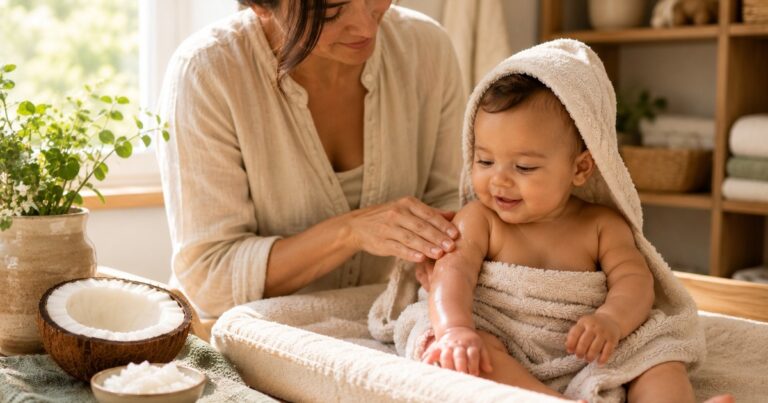
When sensitive baby skin needs moisture, simplicity rules here too. A plain, fragrance-free moisturizer or a simple balm — a short list of gentle, recognizable ingredients — is what you're after.
Rich, simple balms can be lovely for dry patches, but for a baby, run any new moisturizer past your pediatrician first, and patch-test before broader use. And remember from our newborn guide: sometimes skin that looks dry is just fine on its own and doesn't need a product at all. Moisturize sensitive baby skin when it genuinely helps, with the simplest thing possible — not on a schedule out of worry. Your pediatrician can tell you whether moisturizing is warranted for your baby's skin.
The diaper area on sensitive skin is a place to be especially gentle — and especially guided by your pediatrician.
I'm deliberately not prescribing a product here, because for sensitive skin especially, this is a your-pediatrician-knows-best area. They can recommend what's appropriate and flag anything that needs a closer look.
Before any new product goes broadly onto sensitive baby skin, patch-test — and for reactive skin, check with your pediatrician even before patch-testing.
Introducing products one at a time is the secret to knowing what your baby's skin likes or dislikes. Change five things at once and a reaction tells you nothing.
The most important section in this whole guide: sometimes the answer isn't a better product — it's a pediatrician.
There is no product, natural or otherwise, that substitutes for a pediatrician looking at troubled baby skin. If yours is genuinely struggling, please make that call — it's the best thing you can do for your little one, and far more effective than working through the shelf.
Pulling it together, here's what a sensible kit for sensitive baby skin actually looks like — short and simple:
A minimal kit isn't just cheaper and simpler — for sensitive skin, fewer products means fewer chances to react. Restraint is a feature.
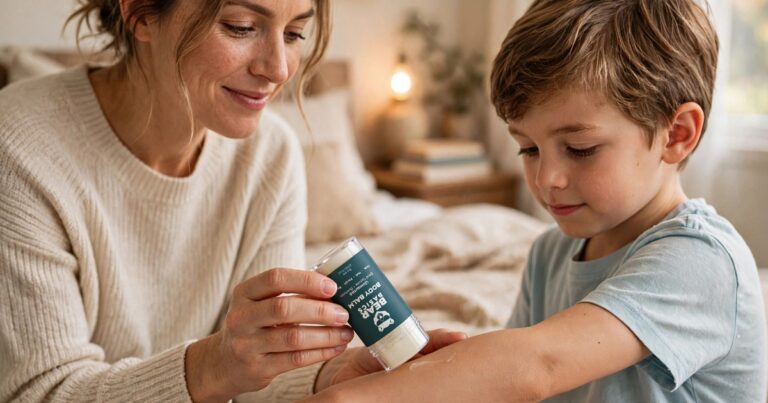
We make simple things — short-ingredient, fragrance-free balms — and I won't pretend they're a magic answer for sensitive baby skin, because no product is. What I'll say honestly is that they're built on the same principle this whole guide is about: a short, recognizable list with nothing extra to react to.
But the honest advice is bigger than our products: for your baby's sensitive skin, choose the simplest, gentlest, fragrance-free option — ours or anyone's — always run new products past your pediatrician, and treat reactive skin as a medical question first. If a simple balm helps a dry patch with your pediatrician's okay, wonderful. If your baby needs a doctor, that comes first, every time. See our simple range if it's useful — with those caveats front and center.
The best natural products for baby's sensitive skin are the simplest ones: short, recognizable ingredient lists, fragrance-free, and gentle. Ignore marketing words like "natural" and "hypoallergenic" that don't guarantee anything, read the actual ingredient list, patch-test one product at a time, and keep the whole kit minimal — fewer things to react to.
Above all, treat reactive or troubled skin as a pediatrician's question, not a shopping problem. Simple gentle products support healthy baby skin; your pediatrician cares for skin that needs more. Get that order right and you're doing beautifully by your little one. For the youngest babies, pair this with newborn skincare: how little is actually enough?
Megan co-founded Bear Basics and leads design. As a mom, she writes our gentlest guides — for pregnancy, postpartum, newborns, and little ones — with an emphasis on simple, safe, and honest. Read the full story →