Spend $50, Get 10% Off

The switch is easy once you know the timeline. Here's exactly what happens, week by week, plus how to prep and how to make it stick — so the adjustment never catches you off guard.

Most people settle into natural deodorant within one to two weeks, and feel fully normal by about a month. Days 1–3 are getting used to it; week one is the most noticeable as your body sweats normally again without aluminum; week two calms down; and by weeks three to four it's just your new routine. The single most important rule: don't quit during week one — that's the peak of the adjustment, right before it gets easy.
The whole switch gets easier the moment you change one expectation. If you're coming from an antiperspirant, you've spent years judging your underarms by dryness — because that's what an antiperspirant delivered. A natural deodorant asks you to judge by smell instead.
That's the real adjustment. A deodorant controls odor and lets your body sweat normally; it doesn't stop sweat. So during the switch, you'll notice more wetness than you're used to, and your brain will want to file that under "this isn't working." It is working — it's just working on odor, not sweat. Hold that distinction and the whole timeline below makes sense. It's genuinely the single biggest predictor of who has an easy switch and who has a miserable one — not skin type, not the brand, but whether you walked in expecting dryness or expecting freshness.
For the first couple of weeks, do a real end-of-day sniff test instead of judging by how damp you feel at noon. Most people are surprised to find that on the days they were sure it "failed," they didn't actually smell.
Understanding the mechanism removes the mystery. When you stop using an antiperspirant, your sweat glands — which were being partially blocked by aluminum — start working normally again.
The "adjustment" is simply your sweat and skin returning to their natural rhythm after aluminum stops reducing your sweat. It's a settling-in period, not a cleanse or a detox — nothing is being pulled out of you.
For a week or two, that means more wetness and sometimes more odor while everything resets and your routine adapts. It's temporary and completely normal. Knowing that in advance is half the battle — the people who struggle with the switch are almost always the ones who expected it to feel identical to their antiperspirant from day one.
A little setup makes the transition noticeably easier. Before you start:
Both work. Cold turkey gets the adjustment over faster; alternating for a week can feel gentler. Pick whichever you'll actually stick with — committing through week one matters more than the method.
The opening stretch is mostly about getting used to the feel and the habit. You're learning how much to apply, how it goes on, and when you like to reapply. Some people notice a little more odor as their routine resets; plenty notice nothing at all. Both are normal. There's no need to panic-scrub or overwash in these first days either; gentle, ordinary washing is plenty, and harsh antibacterial soaps can actually work against you by disrupting your skin's balance.
Apply to clean, dry skin — straight out of the shower, pat dry first, then apply. A wet underarm dilutes the product and makes it feel like it's not doing its job. These first few days set the routine you'll settle into, so keep it simple and consistent.
This is the week people talk about, and the one that trips them up. Sweat and odor can feel more present now because your body is doing its normal thing without a blocker, and your skin's balance is still resetting.
Week one is the peak of the adjustment, not a preview of forever. This is exactly when most people give up — right before it gets dramatically easier. If you make it through week one, you've done the hard part.
Reapply midday if you want to, keep measuring by smell rather than wetness, and remind yourself this is the temporary part. It genuinely gets better from here. If you can, avoid scheduling your switch right before a wedding, a big presentation, or a beach trip — starting during an ordinary, low-stakes week takes the pressure off and makes week one far easier to shrug off.
If it helps, mark it on a calendar: give yourself a firm "reassess on day 14" date and agree not to make any final judgment before then. Having a defined endpoint turns week one from an open-ended ordeal into a short, bounded experiment. Almost everyone who reaches that day-14 checkpoint is glad they didn't bail on day five — the version of you at two weeks is having a very different experience than the version at day three.
By the second week, most people find things calm down. Odor becomes easier to manage, the routine starts to feel automatic, and the wetness you noticed early on feels more normal and less alarming. Your skin and sweat are finding their new rhythm.
This is the turning point. The contrast between week one and week two is what convinces most people the switch was worth it. If week two still feels rough, that's your cue to check a couple of things — usually the formula (baking soda) or your application technique — which we'll cover below. And if week two feels great, resist the urge to celebrate by skipping days — consistency is exactly what got you here.
It's also normal for the improvement to be uneven rather than a clean straight line. You might have two great days and then a hot, sweaty one that feels like a step back. That's not a relapse — it's just your body and the weather, and it evens out. Look at the trend across the week, not any single day, and you'll almost always see things heading in the right direction.
By weeks three and four, the switch is mostly behind you. Odor is well controlled, you've stopped thinking about it, and reapplying is something you do only when you actually need to. This is the settled phase — your new normal, and it tends to hold.
You'll know you're through the switch when you realize you haven't thought about your deodorant in days. That quiet non-event is the goal — fresh, aluminum-free, and off your mind. It's a small, quiet win, but a real one — and it's the payoff waiting on the other side of two weeks of patience.
From here, it's just maintenance: apply daily, reapply when needed, and enjoy not thinking about it. Many people find that once they're settled, they can go longer between reapplications than they expected — the frantic midday touch-ups of week one fade away, and a single morning application often carries a normal day just fine.
You'll see "armpit detox" all over the internet during your switch, often attached to charcoal masks and dramatic claims. Let's keep it simple: there's no literal toxin being pulled from your armpits. Your sweat glands aren't a filter that clogs and needs cleansing.
What people are calling a detox is exactly the adjustment period we've been walking through. Naming it a "detox" makes a normal transition sound like a medical event — it isn't. You can use a soothing mask if you enjoy the ritual, but you don't need one, and skipping it won't slow anything down. Simpler is fine, and usually better.
A quick reference for the switch, so you know when to relax and when to change something:
| Totally normal | Worth a change |
|---|---|
| Sweating more than before | Redness, stinging, or a rash |
| A week or two of more odor | Burning right after applying |
| Needing a midday touch-up | Irritation that won't calm down |
| Feeling damp on hot days | Odor still unmanaged past ~3 weeks |
The left column is the switch working as designed. The right column means it's time to adjust the formula or your routine — not to give up on going natural.
The distinction that matters most here is comfort versus odor. More sweat and a bit more smell are the expected costs of the adjustment, and they pass. Pain, burning, or a spreading rash are not part of any normal switch and shouldn't be endured — they're a signal to change something (almost always the baking soda) rather than to tough it out. Never confuse "pushing through the adjustment" with "ignoring irritation."
The distinction that matters most on this table is comfort versus odor. More sweat and a bit more smell are the expected costs of the adjustment and they pass. Pain, burning, or a spreading rash are not part of any normal switch and shouldn't be endured — they're a signal to change something (almost always the baking soda) rather than to tough it out. Never confuse "pushing through the adjustment" with "ignoring irritation."
Application matters more during the transition than any other time. A few habits make it noticeably smoother:
None of this is fussy — it's about ten seconds of technique that helps the product do its job while your body adjusts.
If you get redness, itching, or a stinging rash during the switch, don't blame "natural deodorant" and quit — the culprit is almost always one specific ingredient.
Baking soda is a common odor-fighter, but it's alkaline and can irritate sensitive underarms. Switch to a baking-soda-free formula (many, including ours, use magnesium instead), give your skin a few days to calm down, and the reaction usually resolves. If irritation persists, take a break and check with a professional.
This one change rescues a huge number of "natural deodorant hates me" stories. If a previous switch failed on irritation, baking-soda-free is very likely your fix.
Past the two-week mark and still struggling? Run through this before giving up:
One of these solves it for most people. For more, see natural deodorant not working? six fixes before you give up.
Getting through the switch is one thing; making it a permanent, easy part of your routine is another. A few habits help:
Steady, daily use is what lets your body settle into its new normal — bouncing back and forth just keeps you in the adjustment zone longer.
If you do want to keep an antiperspirant for rare, specific occasions, that's completely reasonable — just treat it as the exception, not a daily fallback. The people who struggle most are the ones who half-commit, switching every other day and never letting their body find its rhythm. Pick natural as your default, use the backup sparingly, and you'll clear the adjustment far faster than someone who keeps one foot in each camp. Think of it like breaking in a new pair of boots: a little discomfort at first, then a comfortable fit you forget you're wearing — as long as you actually wear them.
Here's the honest reward at the end of the timeline: for most people who push through the adjustment, the switch simply disappears into the background. You end up aluminum-free, comfortable, sweating normally, and no longer thinking about it — which is exactly where you want to be.
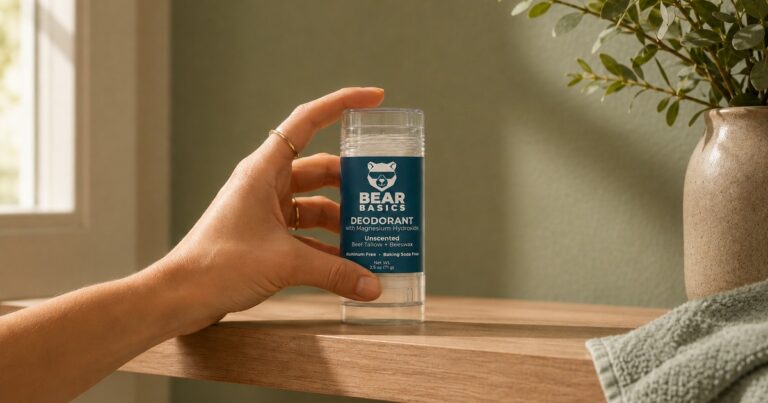
The whole game is getting through the first two weeks so you reach the settled phase. Prep a little, measure by smell, go baking-soda-free if you're sensitive, and don't quit in week one. Our aluminum-free, baking-soda-free deodorant is built for exactly this transition — browse the underarm line and give it the honest two weeks.
Ian founded Bear Basics on one idea: personal care built from a short list of food-grade ingredients we all recognize. Everything is small-batch and made in Colorado. Read the full story →