Spend $50, Get 10% Off

Seven real, science-grounded reasons tallow works so well on skin — honestly framed, with a clear line between what it genuinely does and what it doesn't.

Beef tallow's main skin benefits are deep lasting moisture, fats that resemble your skin's own, support for the skin barrier, naturally occurring fat-soluble vitamins, low-comedogenic tolerance, single-ingredient simplicity, and cushioning comfort for weather-worn skin. The through-line is compatibility — tallow's fats are close to human sebum, so it absorbs and supports rather than sitting on top. These are moisturizer benefits grounded in barrier science, not medical claims.
Search "beef tallow benefits" and you'll find lists promising the moon. This one is deliberately more careful — every benefit below is a real, describable property of tallow, framed as what it actually is: an excellent simple moisturizer.
Here's the key idea that ties the whole list together: tallow's fats closely resemble the oils your own skin produces. That single fact — compatibility with skin — is the root of nearly every benefit that follows. It's why tallow absorbs well, supports the barrier, and feels at-home on dry skin instead of sitting on top like a coating. Keep it in mind as you read; the seven benefits are really seven expressions of that one property.
Tap any chip above to jump to a specific benefit, or read straight through — each one stands on its own, so there's no wrong order.
One quick reframe before we start. It's tempting to read a benefits list as a stack of separate superpowers, but tallow doesn't work that way. It's one honest, simple fat doing what a good moisturizer does — and doing it unusually well because of how closely it matches your skin. So as you go down the list, notice that the benefits aren't competing features bolted together; they're the natural consequences of that one compatibility, seen from seven different angles. Keep that lens and the list stops feeling like marketing and starts feeling like a single, well-understood fact about a simple ingredient.
Since the title promises science, let's be honest about what that means — because that honesty is exactly what most benefit lists skip.
The strong part is skin-barrier science: your barrier is built from fatty acids and lipids, and compatible fats support it. Tallow fits that mechanism well. The honest limit: large clinical trials on tallow specifically are limited, so the benefits below rest on well-established barrier biology and compatibility, not a mountain of head-to-head studies.
That's not a weakness so much as honest framing. Plenty of gentle, effective moisturizers work by exactly this barrier-support mechanism. We're just not going to dress a good moisturizer up as a clinically proven treatment. For the deeper version, see is beef tallow good for your skin?
It also helps to know why the big trials don't exist: tallow is cheap, unpatentable, and un-trademarkable, so there's little commercial incentive to fund expensive studies on it. Absence of trials isn't evidence it doesn't work — it often just means nobody stood to profit from proving what generations of people already observed at their own bathroom sinks. That's the grown-up way to hold it: promising and well-reasoned, with an honest asterisk about the formal literature.
Tallow is concentrated and water-free, so a little lingers and keeps sealing moisture into the skin — right where dry, tight, flaky skin needs it.
The science: as an occlusive-rich fat, tallow helps slow water loss from the skin's surface, so hydration stays put instead of evaporating. It's a big reason people with stubborn dry skin find it works where water-based lotions leave them tight again within the hour. A practical tell: if your current moisturizer feels great for twenty minutes and then your skin feels tight again, that's water evaporating out. A concentrated fat like tallow gives the skin something durable to hold onto, so the comfort lasts through the afternoon instead of fading.
Tallow's fatty-acid makeup closely resembles the oils your own skin produces, so it tends to absorb and settle in rather than sitting on top as a greasy film.
The science: this is the "biocompatible" idea — a fat whose profile is close to human sebum. That resemblance is the single biggest reason tallow behaves so naturally on skin, and it underpins nearly every other benefit on this list. You can actually feel this difference on application: tallow tends to warm, spread thin, and settle in, rather than beading up or leaving a slick you have to wait out before getting dressed. That "sinks in" quality is compatibility in action.
Your skin's outer barrier is built largely from fatty acids and lipids. Tallow is rich in compatible fats, so it can support that barrier and help it do its job of keeping moisture in and irritants out.
The science: skin-barrier biology is well established, and ingredients rich in barrier-compatible fats are a recognized way to support it. This is the most solid, describable part of tallow's case. A healthy barrier is what keeps water in and everyday irritants out, so supporting it isn't a cosmetic nicety — it's the foundation of comfortable skin. When your barrier is stressed by cold, wind, or over-washing, a compatible fat gives it reinforcement to work with rather than just masking the dryness on top.
Grass-fed tallow naturally carries fat-soluble vitamins — A, D, E, and K among them — riding along in its fats.
The honest framing: this is a genuine bonus, not the headline. The reliable benefit is the barrier-supporting fats, with the vitamins as a welcome extra. Grass-fed sourcing is what makes the vitamin content more meaningful — and it's not a reason to treat tallow like a supplement. We spell this out because "packed with vitamins" is one of the most over-hyped tallow claims online. The vitamins are real and welcome, but if a product leans on them as its main selling point, that's a flag the marketing is outrunning the substance. Lead with the fats; let the vitamins be the bonus.
Everything on this list is a moisturizer benefit. Tallow does not treat eczema, acne, or any skin condition, and the naturally occurring vitamins are a bonus, not a treatment or a supplement. For anything medical, see a dermatologist.
Most people use tallow on face and body without clogged pores or congestion, which makes it a friendlier rich moisturizer than its richness might suggest.
The science: animal fats aren't on the classic plant-oil comedogenic charts, so there's no pinned number — but tallow's skin-like profile is part of why congestion is uncommon. Acne-prone skin can patch-test to be sure. It's also worth remembering that how a finished balm behaves depends on the whole recipe, not just the tallow — a light, well-made balm feels very different from a heavy one. That's why patch-testing the actual product beats worrying about a single ingredient's rating in the abstract.
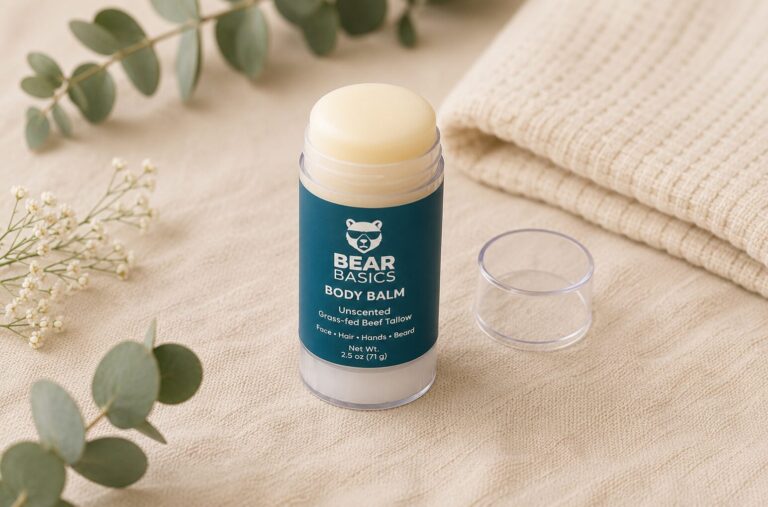
A good tallow balm is one thing: grass-fed beef tallow. Fewer ingredients means fewer unknowns and fewer things that can irritate reactive skin.
The science of simplicity: many skin reactions trace to fragrances, preservatives, or additives — none of which a single-ingredient tallow balm contains. For sensitive skin, a short list is genuinely a feature. There's a quiet confidence in a one-ingredient label, too: the maker is trusting the ingredient to do the work on its own, without a stack of fillers to prop it up. When you can read and recognize everything in a jar, you can actually make an informed choice about what goes on your skin every day.
On the parts of you that take a beating — hands, knuckles, elbows, heels, wind-chapped cheeks — tallow's rich texture cushions and comforts rough, dry patches.
The science: the same barrier-sealing quality that helps dry skin also shields exposed skin from moisture loss in cold, dry, or windy conditions. In a place like Colorado, that protective comfort is exactly what winter skin is asking for. Think of it as a light, breathable layer of insulation for your skin against the elements — not sealing it off, but giving it backup where the wind and dry air hit hardest. That's why it shines on the exposed, hard-working spots that take the most abuse: the backs of hands, knuckles, and cheeks.
If there's an eighth benefit hiding in this list, it's an intangible one: tallow is refreshingly low-effort. There's no routine to memorize, no active to introduce slowly, no waiting for it to "kick in" over weeks. You put a little on, it sinks in, your skin feels better. For anyone who's bounced off complicated ten-step regimens, that simplicity is its own reward.
That low-friction quality is also why people actually stick with it — and consistency is where skincare benefits really come from. The best moisturizer in the world does nothing in the jar; the one you'll reach for every night is the one that helps. A single, pleasant, recognizable balm tends to become a habit in a way that a fussy regimen never does. In that sense, "simple" isn't a lesser benefit than the barrier science — it's the thing that lets all the other benefits show up in real life.
It fits how we think about everything at Bear Basics: the goal isn't to give you more to do, it's to give you less to worry about. A short list of food-grade ingredients, doing honest work, so personal care stops being a project.
Benefits only show up if you use tallow well. A few small habits make a real difference:
A thin, absorbed layer beats a greasy coat every time — with tallow, using more is genuinely counterproductive, since excess just sits on the surface and transfers to your clothes instead of doing anything useful. For a full dry-skin routine, see the best everyday routine for naturally dry skin.
Timing is the underrated part. The few minutes right after a bath or shower, while skin is still slightly damp, are the sweet spot — you're trapping water that's already in the skin rather than trying to add moisture to a dry surface. Pat (don't rub) mostly dry, then apply your thin layer. That one habit gets you noticeably more out of the exact same jar, and it's the difference between tallow "being okay" and tallow genuinely transforming how comfortable your dry skin feels day to day.
Tallow's benefits land hardest for some people:
If you're on the right, a lighter oil or a tallow-coconut blend may suit you better — see beef tallow vs coconut oil. The benefits are real, but they're best matched to skin that actually wants richness.
This is worth saying plainly because a lot of skincare content pretends one ingredient is right for everyone. Tallow isn't magic and it isn't universal — it's exceptionally good at a specific job. Matching it to skin that wants that job done is how you get the benefits on this list; forcing it onto skin that wants something lighter just leads to disappointment. Honest fit beats hype every time.
An honest benefits list has to name the limits:
Kept in its lane — a simple, barrier-supporting moisturizer — tallow delivers everything on this list. Asked to be a medicine, it isn't.
Holding that line actually protects you. If a dry patch turns out to be eczema or a rash that needs real care, treating it as "just dry skin" and reaching for more balm can delay the help it needs. Tallow is a wonderful everyday moisturizer and a poor substitute for a diagnosis — knowing the difference is part of using it wisely.
Seven benefits, one root cause: tallow's fats resemble your skin's own, so it moisturizes deeply, supports the barrier, and comforts weather-worn skin — with naturally occurring vitamins and single-ingredient simplicity as real bonuses. The science that backs it is barrier biology and compatibility, honestly framed, not overhyped trials.
If your skin is dry, mature, or hard-working, those benefits are genuinely worth having from something this simple. Choose grass-fed, use a little on damp skin, patch-test, and see a dermatologist for anything medical. And keep your expectations honest — you're getting an excellent, barrier-supporting moisturizer, not a miracle, and that's exactly enough. Explore our beef tallow line to put the list to the test.
Ian founded Bear Basics on one idea: personal care built from a short list of food-grade ingredients we all recognize. Everything is small-batch and made in Colorado. Read the full story →