Quick answer
Preservatives control the growth of bacteria, yeast, and mold in products that contain water — which is every cream, lotion, serum, and wash on your shelf. Microbes need water to live, so a water-containing formula is a hospitable environment, and contamination arrives routinely from air, manufacturing, and fingers dipping into jars. The uncomfortable part is that microbial growth is usually invisible: a contaminated cream often looks, smells, and feels completely normal. That’s why “preservative-free” on a water-based product is a red flag rather than a virtue, and why an unpreserved homemade cream is a genuinely bad idea. It’s also why our balms don’t contain any — not principle, but structure: no water, nothing to preserve against. And vitamin E is not a preservative; it’s an antioxidant solving an entirely different problem.
Answers at a glance6 quick questions
Why needed?
Water lets microbes grow.
Preservative-free cream?
Red flag, not a feature.
Can you see it?
Usually not.
Vitamin E?
Antioxidant — different job.
Why not in balms?
No water to preserve.
DIY creams?
Don’t keep them.
01 The short answer
Preservatives are the most misunderstood ingredients in skincare. They’re routinely listed among things to avoid, marketed against, and blamed for a general sense that products are full of unnecessary chemicals — and they are, in a water-containing product, doing some of the most straightforwardly protective work on the entire label.
The logic is simple enough to state in a sentence: microbes need water, so anything containing water needs something controlling what grows in it. Bacteria, yeast, and mold don’t require an invitation — they arrive from air, equipment, packaging, and every finger that goes into a jar. A preservative system keeps that under control for as long as the product is in use.
We’re an unusual brand to be making this case, since nothing we currently sell contains a preservative. But that’s a consequence of making water-free balms, not a position on the ingredients — and with a cream in development, we’d rather explain the reasoning now than be asked later why the ingredient list grew.
02 What preservatives actually do
What the job actually is:
- Controlling microbial growth — bacteria, yeast, and mold — inside the product, across its shelf life and its in-use life after opening. That’s the whole remit.
- Not sterilizing. A preserved product isn’t microbe-free; the system keeps introduced organisms from multiplying to problematic levels. It’s ongoing control rather than a one-time purge.
- Broad spectrum matters. Bacteria, yeasts, and molds are different organisms with different vulnerabilities, which is why preservation is usually a system of complementary ingredients rather than a single one. A formula protected against bacteria but not mold isn’t protected.
- It has to work in that specific formula. Preservatives can be affected by pH, by other ingredients, and even by packaging. Effectiveness is a property of the finished product, not of the ingredient in isolation — which is why section 9 exists.
The framing that changes how you read a label
Ingredients in a water-based moisturizer split roughly into ones that serve your skin, ones that serve the formula, and ones that serve the sale. Preservatives sit squarely in the middle group — they serve the formula so the formula can safely serve you. That’s not filler, and it isn’t marketing. It’s the ingredient equivalent of a seatbelt.
03 Why water is the whole issue
Why water specifically:
- Microbes need water to metabolize and reproduce. No available water, no growth — which is the same principle behind drying and salting food, and it’s been understood for a very long time.
- A cream is a hospitable environment. Water, plus organic material in the form of oils and other ingredients, at room temperature. From a microbe’s point of view that’s a reasonable place to live.
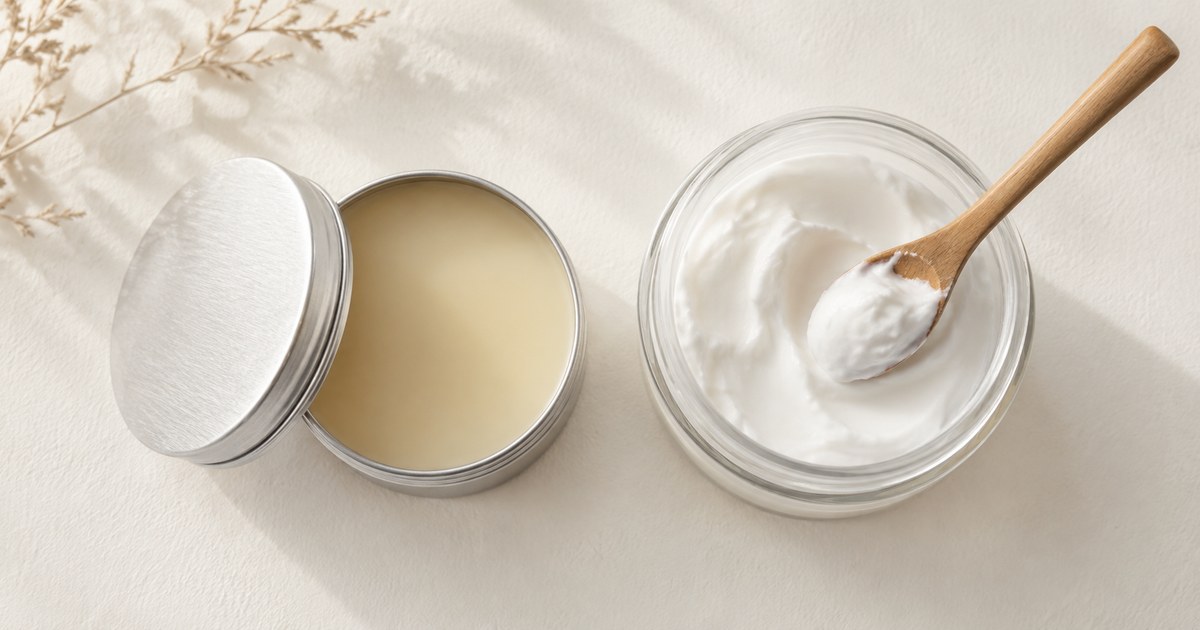
- Anhydrous formulas are not. Fats and wax with no water phase give microbes nothing to work with. This is why our water-free products don’t need preservation — it’s biology, not restraint.
- Which means the format decides the requirement. Balms, oils, and anhydrous scrubs: no preservative needed. Creams, lotions, serums, washes, mists: preservation is mandatory, without exception.
- And borderline cases exist. A product that is technically anhydrous but gets water introduced during use — a scrub kept in the shower, a balm used with wet fingers — can still develop problems, which is why the storage advice about keeping water out of jars applies even to our own products.
04 Where the microbes come from
The routes contamination takes, which explain why the risk isn’t hypothetical:
- Manufacturing. Even careful production isn’t sterile. Water supply, equipment, air, and raw materials can all introduce organisms — which is why commercial manufacturing has hygiene controls and why preservation is designed in from the start.
- Packaging and filling. More opportunities, particularly for open-mouthed jars.
- Air, on first opening. Everything in the room enters the container the moment the lid comes off.
- Fingers — the big one for consumers. Every dip introduces whatever was on your hands into a warm, water-containing product. Over weeks of daily use, a jar accumulates a lot of introductions.
- The bathroom itself. Warm, humid, and a cheerful environment for growth — which is part of why the shower shelf is such a poor address for anything, as covered in the storage guide.
Preservation exists because all of that is normal and unavoidable. The system isn’t compensating for sloppiness; it’s handling the ordinary reality of a product being made, opened, and used by a person.
05 What contamination looks like (often nothing)
The fact that makes this genuinely important rather than academic: you usually can’t tell.
- Microbial growth is often invisible. A contaminated cream can look, smell, and feel entirely normal while carrying a substantial microbial population. The dramatic signs — visible mold, separation, an off smell — represent an advanced stage, not the beginning.
- Which removes your ability to check. With a fat-based balm, your nose is a genuine test: rancid fats smell sharp and unmistakable, which is the check we recommend in the storage guide. There’s no equivalent consumer test for microbial contamination in a cream.
- So you’re relying on the formulation. Not on vigilance, not on inspection — on whether the product was properly preserved and tested before it reached you.
- And on respecting the window. The period-after-opening figure exists because preservative systems have working lifespans. A cream that seems fine six months past its window may well be fine; it may also be exactly what a quietly failing system looks like.
- If you do see something — discard it. Visible mold, separation that won’t remix, colour change, or an off smell in a water-based product: no rescue attempts, no scraping off the top layer.
06 Preservative vs antioxidant
A distinction worth getting right, because it’s constantly blurred in natural skincare marketing:
- Preservatives control microbes. Living organisms, growing in water.
- Antioxidants slow oxidation. A chemical process where oxygen degrades fats — what makes oils go rancid. No organisms involved.
- Vitamin E is an antioxidant. It’s in our formulas to protect the fats from oxygen, and it does that job well — the full explanation is in its own profile. It is not a preservative and cannot substitute for one.
- Which makes a specific claim dangerous: a water-containing product describing vitamin E, rosemary extract, or similar as its “natural preservative” has confused two different problems. Those ingredients don’t reliably control microbial growth in a water phase, whatever else they do.
- Both problems can exist at once. A cream needs preservation for the water phase and often an antioxidant for the oil phase. Seeing both on a list isn’t redundancy; it’s two jobs being covered.
If you take one label-reading skill from this article, take this one: when a water-based product claims to be preserved by an antioxidant, that’s not a preservation system.
07 The “preservative-free” problem
Which brings us to a claim that appears on real products: “preservative-free.”
- On an anhydrous product, it’s true and unremarkable. Our balms are preservative-free because there’s no water in them. Accurate — and not much of an achievement, which is why we’d rather explain the reason than put it on a label as a boast.
- On a water-containing product, there are only two possibilities. Either the product genuinely has no preservation and is vulnerable to microbial growth, or it does contain something performing that function and the claim is playing games with terminology.
- Neither possibility is reassuring. One is a safety problem; the other is a transparency problem. A brand willing to be slippery about preservation is telling you something about how it handles the rest of its label.
- “Self-preserving” formulas do exist as a legitimate technical approach — using very low water availability, pH control, packaging, and other strategies. But that’s a sophisticated formulation achievement requiring testing to demonstrate, not a default a small brand can claim by intention.
- The reasonable position: if a product has water in it, you want it preserved, and a brand that treats preservation as something to apologize for has the priorities backwards.
08 Why the fear took hold
Being fair about why so many people distrust these ingredients — the fear didn’t arrive from nowhere:
- Specific preservatives have been genuinely controversial. Some have been restricted or phased out over time as evidence developed, and public debate about particular ones has been loud and long-running. That history is real, and treating it as pure hysteria would be dishonest.
- Contact allergy to specific preservatives is a documented thing. Certain ones appear on dermatology patch-test panels precisely because some people react to them — the same panels where fragrance features so prominently.
- But the response that follows doesn’t track. “Some individuals react to preservative X” supports identifying which one and avoiding it — the debuggability argument — rather than removing the entire category from water-based products where it does essential work.
- The marketing amplified it. “Free from” claims sell, and preservatives were easy to villainize because their benefit is invisible while their name sounds industrial. Nobody notices the contamination that didn’t happen.
- Which is the pattern we keep meeting — a real, narrow concern inflated into a categorical rule, exactly as with seed oils. The useful move is the same: understand the mechanism, then judge the specific case.
Want the free family bundle?Two Color & Grow coloring books, our Fam Jams family music, and a plain-English skincare guide — free. Grab the bundle — instant download. 09 How preservation is actually tested
The part consumers never see, and the reason preservation is a formulation discipline rather than an ingredient purchase:
- Preservative efficacy testing. Finished products are deliberately inoculated with known organisms, then sampled over time to confirm the population is being controlled. It’s a standard part of bringing a water-containing cosmetic to market responsibly.
- Testing the product, not the ingredient. A preservative that works beautifully in one formula can underperform in another because of pH, oil content, or interactions. Efficacy is a property of the finished thing.
- Packaging counts as part of the system. A pump or tube that keeps fingers and air out is doing preservation work; an open jar demands more of the chemistry.
- Stability testing runs alongside it — confirming the product holds together and stays effective over time and across temperature swings, which is a separate question from microbial control.
- Which is the honest reason a cream is a bigger project than a balm. Not the mixing — the validation. Anyone can emulsify oil and water in a kitchen; demonstrating that the result is safe for months in a customer’s bathroom is the actual work.
10 Reading preservation on a label
How to read preservation on a label, practically:
- Look at the end of the list. Preservatives are used at low percentages, so they sit near the bottom — that position is expected and correct, not a sign of insignificance.
- Water at the top means preservation below. If the first ingredient is water or aqua and you can’t identify anything performing preservation, that’s worth a question.
- Unfamiliar names aren’t a verdict. Preservative names sound industrial because chemical nomenclature does. Length and pronounceability tell you nothing about safety — a point from the label-reading guide that applies here more than anywhere.
- Check the period-after-opening symbol and respect it — particularly on water-based products, where the number reflects how long the system is expected to hold.
- If you’ve reacted before, identify the specific one. That’s useful, actionable information for future shopping — and far more useful than avoiding a whole category.
- And favor better packaging where you have the choice: pumps and tubes reduce contamination compared with wide-mouthed jars.
11 Homemade skincare and the water rule
A practical warning, because homemade skincare recipes circulate widely and most of them ignore this entirely:
- Homemade water-containing products are not safe to keep. No tested preservation, non-sterile conditions, and contamination that’s usually invisible. A DIY lotion in a jar on a bathroom shelf is a genuinely poor idea, regardless of how wholesome the ingredients were.
- “Natural” changes nothing here. Microbes are entirely indifferent to whether your ingredients came from a health food shop — another case where the word carries no safety information.
- Anything with water counts — recipes using aloe juice, hydrosols, floral waters, tea, or milk are water-based products even when nothing says “water.”
- The sensible DIY category is anhydrous. Balms, salves, oil blends, and body butters made purely from fats and waxes sidestep the problem structurally — which is why they’re the traditional home preparations.
- If you do make something water-based, treat it like fresh food: refrigerate, make tiny amounts, and discard within days rather than weeks.
- And for anything going on a baby or on broken skin, homemade is the wrong choice entirely — that’s a moment for a tested product and, where relevant, a doctor’s input.
12 Where this leaves us
Our own position, stated plainly since we’ve spent this article defending ingredients we don’t use:
- Our balms contain no preservatives because they contain no water. That’s the entire reason. We’d rather explain it than let the absence be read as a stance.
- We won’t market “preservative-free” as a virtue. It would be technically accurate and quietly misleading — implying we avoided something risky when we simply chose a format that doesn’t require it. That’s the kind of claim we’d criticize elsewhere.
- A cream from us would be preserved, properly. With a tested system, because the alternative is shipping a contamination risk with a nicer ingredient list. There is no version of this where we make a water-based product and skip that.
- And the ingredient list will be longer — the same warning we’ve now given in the format comparison, the glycerin post, and elsewhere. Preservatives and emulsifiers have jobs we can name in a sentence, which is the standard, and they pass it.
- Nothing is finished, and we don’t pre-sell. But if it arrives, it arrives preserved — and now you know why.
13 The bottom line
Preservatives, in full: they control bacteria, yeast, and mold in products containing water — which means every cream, lotion, serum, and wash — because microbes need water and arrive routinely from air, manufacturing, and fingers. Contamination is usually invisible, so you can’t inspect your way to safety; you’re relying on the formulation and the period-after-opening window.
Which flips the usual instinct: “preservative-free” on a water-based product is a warning, not a feature, vitamin E is an antioxidant and never a substitute, and homemade water-containing skincare shouldn’t be kept. Balms skip all of this by having no water at all — a structural convenience we happen to benefit from, and not a reason to distrust the ingredients that make everyone else’s moisturizer safe.
"Nobody notices the contamination that didn’t happen. That’s the whole problem with marketing against preservatives."— The honest verdict
The 6 things to remember
- Microbes need water — so every water-containing product needs a preservative system.
- Contamination is usually invisible; you can’t smell or see your way to safety in a cream.
- “Preservative-free” on a water-based product is a red flag, not a selling point.
- Vitamin E is an antioxidant, not a preservative — different problem entirely.
- Preservation is tested in the finished formula; packaging is part of the system.
- Homemade water-based skincare shouldn’t be kept — stick to anhydrous balms and oils.
Frequently asked
Why do creams and lotions need preservatives?
Because they contain water, and microbes need water to grow. A water-containing product is a hospitable environment for bacteria, yeast, and mold — introduced from the air, from manufacturing, and from fingers going into the jar. A preservative system controls that growth for the life of the product. Without one, a cream can become contaminated long before it looks or smells wrong.
Are preservatives in skincare bad for you?
Preservatives are among the most scrutinized ingredients in cosmetics, with defined permitted levels and extensive safety review. Some individuals react to specific preservatives, as people can react to any ingredient, and that’s a reason to identify which one rather than to avoid the category. The risk of an unpreserved water-based product is concrete and well documented; the risk from properly used preservatives is far smaller.
Is 'preservative-free' a good thing?
In a water-containing product, it’s a warning sign rather than a selling point — either the claim is misleading, or the product is genuinely vulnerable to microbial growth. It’s only meaningful for anhydrous products like balms and oils, which don’t need preservation because there’s no water for microbes to live in.
Why don't balms need preservatives?
Because they contain no water. Microbes need water to grow, and a formula made entirely of fats and wax gives them nothing to live in. That’s a structural property of the format, not a virtue of the brand — and it’s why we don’t use preservatives, rather than any objection to them.
Isn't vitamin E a natural preservative?
No, and this is a common and consequential mix-up. Vitamin E is an antioxidant — it slows fats going rancid by protecting them from oxygen. Preservatives control microbial growth. Different problems, different solutions. A water-containing product relying on vitamin E as its preservation is not preserved.
How can I tell if a cream has gone bad?
Sometimes you can — separation, colour change, an off smell, or visible mold specks all mean discard immediately. But microbial growth can be well advanced before anything is visible, which is exactly why preservation matters and why the period-after-opening window on the label is worth respecting even when a product looks fine.
What are common preservatives in natural skincare?
Several systems are used in products marketed as natural, including preservatives based on organic acids and various approved broad-spectrum blends. What matters more than the specific name is that the finished product has been tested to confirm the system actually works in that formula — preservation is a property of the whole product, not just an ingredient on a list.
Can I make my own cream without preservatives?
You can make one, but it won’t be safe to keep. Homemade water-containing products have no tested preservation, and kitchen conditions aren’t sterile — contamination is likely and often invisible. If you want to make things at home, anhydrous products like balms and oil blends are the sensible category, because they sidestep the problem entirely.
Megan Smith
Co-Founder, Bear Basics
Megan co-founded Bear Basics and leads design. As a mom, she writes our gentlest, most practical guides — on ingredients, sourcing, and simple family skincare — with an emphasis on honest, well-sourced, and simple. Read the full story →
Water-free, by design.Balms that skip preservatives because there’s nothing to preserve — explained rather than boasted about. Prefer Amazon? Find us there too.Shop the line